NVDA Stock Price Prediction: What Analysts Expect
NVDA stock price predictions are some of the most searched numbers in finance, and the honest answer about where Nvidia goes next starts with why the question is hard. Nvidia is one of the most analyzed companies on Earth, with dozens of sell-side price targets refreshed quarterly, so no prediction, ours or anyone’s, is worth much without a framework. This article gives you that framework: what Nvidia actually earns, what the Street models, what the presenter of Brownstone Research argues is changing underneath the model, and what risks anchor every projection.
What drives the NVDA stock price
Nvidia’s price is a bet on three variables: data center revenue growth, gross margin, and the durability of its near-monopoly in AI accelerators. The company owns the CUDA software ecosystem that nearly every AI lab builds on, its chips power the training of frontier models, and hyperscaler capex keeps setting records. Price targets move when any of those assumptions moves. That is why NVDA predictions diverge so wildly: a stock trading on 30 times earnings and 30% growth is cheap if capex holds and expensive if a single hyperscaler pauses spending.
the presenter’s frame: the first phase is ending
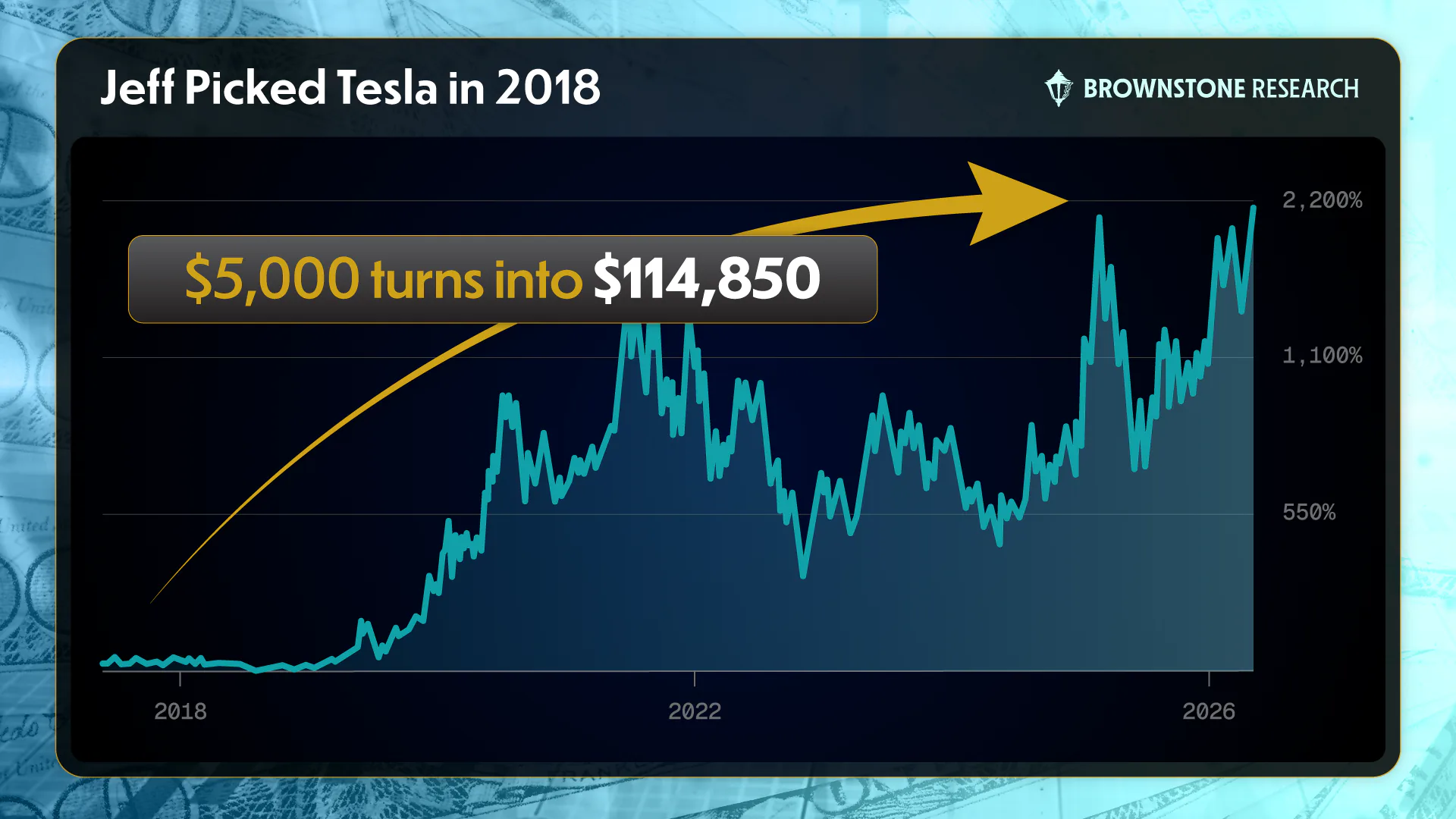
Brown, who recommended Nvidia in 2016 before its 37,800% run and counts it among his career-defining calls, argues the next phase of AI belongs to a different kind of hardware. His pitch, from the “Elon Musk’s One Stock Retirement Plan” presentation: “Most of the investments in AI so far have focused on what I call ‘generic AI.’ And Nvidia was the big beneficiary of that first phase. But the future will be powered by what I call ‘Accelerated AI.’”
Generic AI, in his usage, is the training era: building giant models on clusters of GPUs. Accelerated AI is the inference era: running those models at “speed and scale” for millions of users, where latency, the delay of shuttling data between chips, becomes the bottleneck. His classroom analogy: “It’s like trying to pass a note down a long row of people sitting in a classroom. Every single person who has to take the note and hand it to the next one adds a little delay.”
Brown is not predicting Nvidia’s collapse; he is predicting its next phase of growth. He notes the teased inference company, which our clue analysis suggests is Cerebras (CBRS), has grown sales “about 500% a year since 2022… almost six times faster than Nvidia’s current sales growth,” and is “the same size Nvidia was in 2016.” The structural argument: inference workloads migrate toward architectures built for them, the way internet traffic migrated from dial-up to broadband. “And the companies that made that transition possible made their shareholders incredibly wealthy.”
What analysts actually model
Across recent coverage, the consensus picture for Nvidia looks like this: data center revenue remains the dominant driver, with sovereign AI (government-funded clusters) and inference demand as the incremental growth vectors. The bear debates are well known: hyperscaler capex cannot compound forever, custom in-house silicon (Google’s TPUs, Amazon’s Trainium) absorbs some demand, and export controls cap the China market. The bull debates are equally simple: AI demand keeps outstripping supply, new reasoning models consume far more inference compute than anyone expected, and Nvidia’s annual product cadence keeps pulling customers forward.
For an honest anchor, use Brown’s own disclosure: The Near Future Report’s average gain since inception is 39.4%, against peak picks like Nvidia at 4,100% “if you had held on past their original recommendations and sold at their peak.” Peak-to-peak framing flatters every track record; the average is the number to remember when you see a 37,800% headline.
The Musk catalyst in the pitch
Brown ties his timing to two Elon Musk projects he says are documented in government filings: Terafab, a $119 billion Texas semiconductor plant, and Starmind, an FCC-approved plan to launch “up to one million AI satellites.” His argument is that Musk’s compute buildout multiplies demand for inference capacity, benefiting the smaller company he teases alongside, not instead of, Nvidia. He frames a decision window “before November 11”; treat newsletter dates as marketing urgency, but the underlying buildouts are real public-record projects.
Considerations for any NVDA prediction
Whatever your price target, four risks recur in serious analysis. Concentration: a handful of customers drive most data center revenue, so one budget pause echoes. Competition: AMD’s Instinct line and custom hyperscaler chips take share at the margin. Cyclicality: semiconductors have always been boom-bust, and AI is not exempt from the laws of supply and demand. Valuation: Nvidia must keep executing flawlessly to grow into its multiple. None of these broke the stock so far, which is exactly why they deserve respect rather than dismissal.
Where to learn more
If the inference thesis interests you, Brown’s specific pick and ticker are in “The One-Stock Retirement Plan,” included with a $179 trial of The Near Future Report, protected by a 30-day keep-everything guarantee. For background, read our review of Brown’s 10X Project pitch, the Near Future Report profile, and our the presenter presenter profile. For a different publisher’s take on the same question, see the AI stocks worth watching from our Frontier AI coverage.
NewsletterVetter is an independent publication. We receive compensation from some of the services we review through affiliate links. Nothing on this site is investment advice. Always do your own research.