Training vs Inference: Why the Distinction Matters
Training versus inference is the most important distinction in AI hardware, and it is the distinction the presenter builds his entire “Elon Musk’s One Stock Retirement Plan” pitch around. If you understand the difference, you can evaluate every AI investment claim on the merits; if you do not, every “next Nvidia” teaser sounds equally plausible. Here is the plain-English version, and why the distinction is moving markets.
The distinction, in one breath
Training is building the model: feeding data through a neural network for weeks until it learns. Inference is using the model: producing answers, every request, forever after. Brown’s own compact definition of inference: “It simply means we’re running intelligence at speed and scale.”
The economic difference is the key. Training is a capital project: you spend big, you get a model, the spending stops until the next project. Inference is an operating cost that scales with usage: every user, every chat, every agent action, forever. As AI shifts from models being built to models being used, spending shifts with it, and different hardware gets the money.
Why the hardware differs
Training rewards throughput: raw calculations per second, because nobody is waiting on the result of any single computation. Clusters of GPUs, which is to say Nvidia, dominate: as Brown puts it, “Nvidia was the big beneficiary of that first phase.”
Inference rewards low latency: the time it takes one answer to come back. The problem is that models are too large for one chip, so they are split across many, and the chips must constantly exchange data. Every exchange adds delay. Brown, a former senior executive at Qualcomm and NXP Semiconductors, explains it with the classroom analogy: “It’s like trying to pass a note down a long row of people sitting in a classroom. Every single person who has to take the note and hand it to the next one adds a little delay… That’s called latency in a computing system.” He calls it “a problem that has been plaguing the computer industry for 75 years. Nobody had been able to figure this out… Until now.”
That “until now” is where the investment pitch lives. The company Brown teases, which our clue analysis matches to Cerebras (CBRS), builds wafer-scale chips that put a huge model’s compute on a single piece of silicon, collapsing the note-passing to millimeter-scale hops. Whether its advantage holds against Nvidia’s roadmap and hyperscaler in-house silicon is the open question, not a settled fact.
Why now: the inference wave
Brown’s claim is that inference is becoming the dominant workload as AI turns “fully autonomous and making decisions on its own,” and the use cases he attributes to the teased company’s partners illustrate the demand: OpenAI using the technology “to make ChatGPT respond much faster,” Microsoft “to help software engineers write code faster,” IBM boosting “its flagship AI model called WatsonX,” CrowdStrike enabling “real-time AI security against cyber threats,” and GlaxoSmithKline speeding “its drug research and discovery.” Real-time products fail without low latency, so as AI products go real-time, inference spending compounds.
His master analogy: “Dial up was ‘slow internet’… Broadband was ‘fast internet’… And the companies that made that transition possible made their shareholders incredibly wealthy.” The financials he cites for the teased company: a “$24 billion backlog,” “sold out into 2027,” sales growth “about 500% a year since 2022… almost six times faster than Nvidia’s current sales growth,” and an Amazon/AWS deployment he expects to be detailed on an upcoming analyst call. He ties the demand wave to Musk’s Terafab chip plant and Starmind satellite plan against a “before November 11” date, which should be read as marketing urgency around real catalysts.
What the distinction means for investors
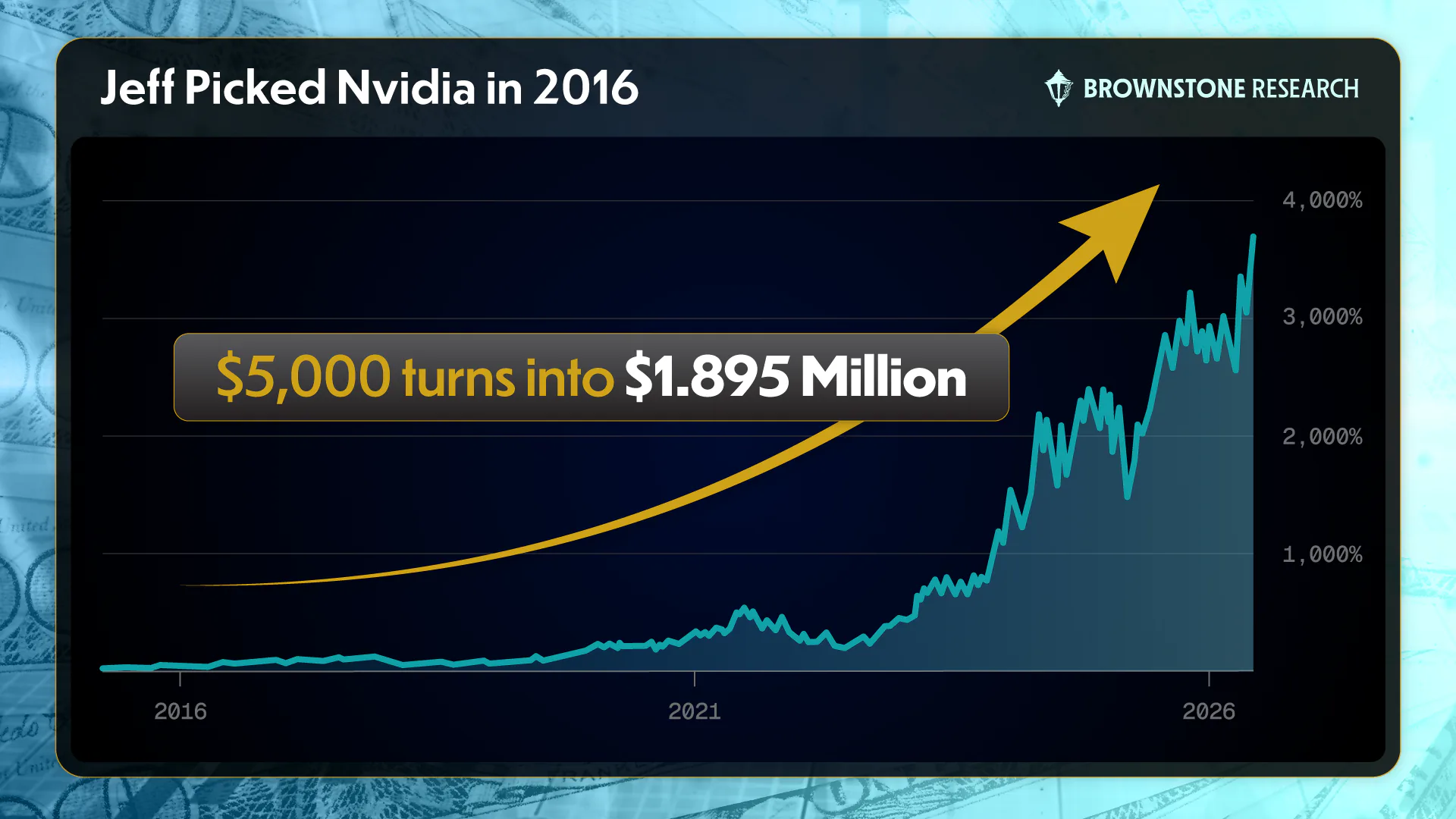
Three practical takeaways. First, when you hear an AI pitch, ask which workload it monetizes: training spend (Nvidia’s phase) or inference spend (the contested next phase). The answer determines which companies get the revenue. Second, average results beat peak anecdotes: Brown’s own Near Future Report discloses a 39.4% average gain since inception, against peak picks like Nvidia at 4,100%, a spread every reader should hold in mind. Third, the shift is real but not winner-take-all: Nvidia, AMD, custom hyperscaler silicon, and new architectures all contest inference, which is an argument for diversification across the theme rather than concentration in one teaser.
Where to learn more
Brown’s specific pick and ticker are in “The One-Stock Retirement Plan,” the lead report with a $179 trial of The Near Future Report, backed by a 30-day keep-everything refund guarantee. For background, read our review of Brown’s 10X Project pitch, the Near Future Report profile, and our the presenter presenter profile. For another publisher’s framing of the same shift, our edge inference piece is a useful contrast.
NewsletterVetter is an independent publication. We receive compensation from some of the services we review through affiliate links. Nothing on this site is investment advice. Always do your own research.