Data Center Construction Companies: Who Builds AI
Data center construction companies are the firms that turn AI capital expenditure into buildings: site work, concrete, steel, electrical distribution, switchgear, transformers, cooling, and the miles of cable that bind it together. They are also the middle layer of one of the largest construction booms in American history, and the reason “data center stocks” keep showing up in every investment presentation, including Marc Chaikin’s “The End of Elon?” pitch for the Power Gauge Report, which we use here as the frame. If you want to know who actually builds AI, this article maps the layers.
The buildout, sized honestly
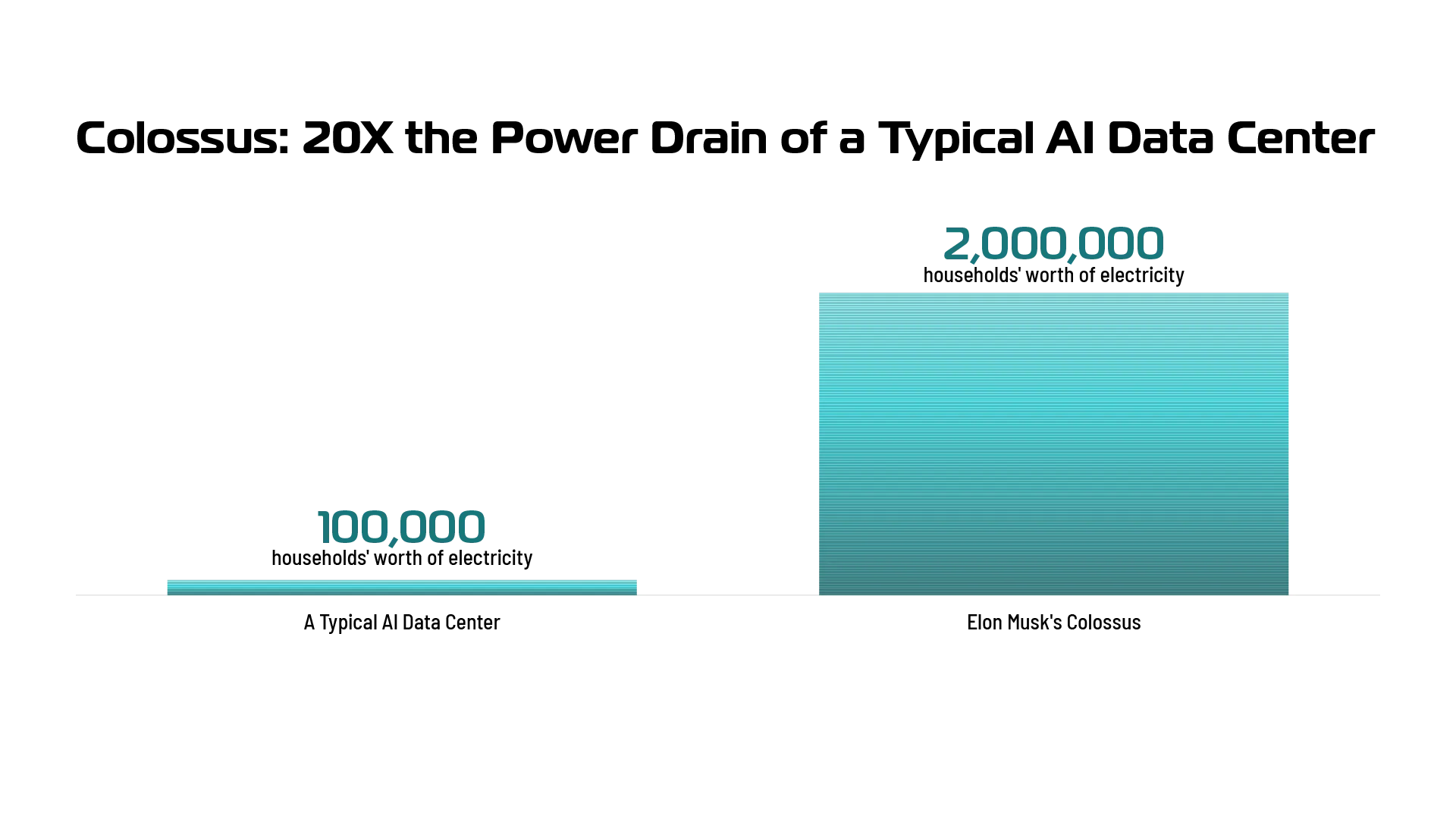
The numbers Chaikin cites in his presentation are a fair introduction to the scale. He references IEA projections that data center electricity use could roughly double by 2030, a Bloomberg study finding electric bills up “by an average of 267% in areas with high data-center concentrations,” and Elon Musk’s Colossus campus covering “1,156 acres,” about a thousand football fields, drawing on the order of two gigawatts. Every one of those campuses is, before it is anything else, a construction project with a multi-year schedule and an electrical system the size of a small city’s.
The layers of the value chain
Site and civil contractors do the land work, foundations, and shell. Engineering-and-construction names like Jacobs Solutions and design-build specialists lead here; our Tech-Opoly series covered this layer in detail.
Electrical equipment makers supply the gear that makes a data center a power system: switchgear, transformers, and distribution. This is where names like Powell Industries, Eaton, and Vertiv come in, and it has been one of the best-performing industrial segments of the buildout, because electrical equipment is the bottleneck commodity of AI. Our pieces on switchgear stocks and transformer stocks map the names.
Electrical distributors - Wesco, Rexel, and peers - move the equipment, and their data-center revenue lines have become a watch item on earnings calls.
Cooling and thermal management suppliers, where Vertiv and Modine play, handle the heat that all that compute generates, increasingly with liquid cooling as rack density climbs.
Mechanical and fire protection contractors, including companies like Comfort Systems, round out the interior work.
The Chaikin twist: smaller data centers, different suppliers
Here is what makes Chaikin’s version of the data center story different from the standard buildout pitch. His argument is that the next generation of AI compute does not look like Colossus. His presentation centers on a new class of FP64-precision machines, “AI micro clusters,” being built at Department of Energy facilities, led by a supercomputer called Lux at Oak Ridge National Laboratory: “the world’s first FP64-powered AI supercomputer,” about “the area of a 7-Eleven convenience store,” drawing “as little as 24 megawatts” against Colossus’s two gigawatts.
If he is right, the construction mix shifts: fewer thousand-acre campuses, more compact scientific facilities retrofitted into existing national laboratories, which means relatively less greenfield civil work and relatively more precision fit-out, networking, and high-density electrical and cooling work. That is why his stock universe, the 17 companies he says “have signed deals” to work on the “American Atlas” supercluster, skews toward chipmakers, networking, and specialized contractors rather than campus builders. His free pick is AMD, whose Instinct accelerators already power the DOE’s Frontier and El Capitan supercomputers; the rest of the portfolio is subscriber content, covered in our American Atlas review.
Considerations
Two risks frame the whole construction-thesis space. First, capex cyclicality: hyperscaler spending is a corporate budget line, and any pause ripples through the supplier chain with a lag; the suppliers’ backlogs, currently long, are the main cushion. Second, the “smaller data centers” scenario Chaikin pitches is a minority view so far; the observable buildout is still getting bigger, not smaller, which argues for owning both profiles rather than betting entirely on one vision.
The honest summary: construction and equipment suppliers get paid while the debate about what AI compute looks like plays out, which is exactly why income-oriented investors like the layer.
Questions readers ask about the construction angle
Why would smaller data centers favor different suppliers? Because the requirements change. The new AI micro clusters are about the footprint of a 7-Eleven convenience store, draw as little as 24 megawatts against Colossus’s 2 gigawatts, and run FP64 scientific workloads rather than consumer inference. A facility like that needs precision compute, high-density power distribution, and specialized cooling, not warehouse-scale shells and megawatt substations. The supplier list tilts accordingly, which is the investment edge in Chaikin’s framing: the market prices data-center construction as one trade, and American Atlas argues it is about to split into two.
What is actually being built? Lux at Oak Ridge, the first node, plus a network the presentation sizes at nine new AI micro clusters and more than 50 converted DOE supercomputers, “all becoming part of one giant AI breakthrough machine.” The 17-company American Atlas Portfolio covers the signed contractors, and the free pick, AMD, already powers the DOE’s flagship machines.
How solid is the timeline? The DOE buildout is real and the administration’s own framing, “a historic national effort, comparable in urgency and ambition to the Manhattan Project,” is quotable. The specific September 29th start date in the presentation carries no stated source, so weight the agency calendar, not the marketing one. See the full review.
Where to learn more
Start with our full End of Elon? American Atlas review, then the 17-company supercluster universe and Oak Ridge, Frontier, and Lux explained. For the traditional buildout suppliers, see data center infrastructure stocks and data center electrical equipment. Chaikin’s reports come with a trial of the Power Gauge Report, normally $499 a year, with a 30-day full-refund guarantee.
NewsletterVetter is an independent publication. We receive compensation from some of the services we review through affiliate links. Nothing on this site is investment advice. Always do your own research.