How Did Musk Get His Money? The Empire’s Origins
“How did Elon Musk get his money?” is one of the most-searched questions attached to the current wave of Musk-themed investment presentations, and the answer is worth stating cleanly, because the empire’s structure explains both his trillionaire moment and the investment theses built around him. Musk’s fortune was not inherited and was not one bet. It is a stack of compounding positions, each of which was called impossible at the time.
Stage one: PayPal
The origin is the payments company. PayPal, in its pre-Elon incarnation, was “voted one of ‘the worst business ideas of 1999’” by contemporaries, in the telling the presentations recycle, and it went on to reshape online payments and deliver the exit that funded everything after. The pattern that defines the whole fortune was set there: enter a market the establishment has written off, survive, and own the infrastructure when the market arrives.
Stage two: Tesla
The auto industry’s most credentialed voices predicted Tesla’s doom twice, and the company instead “has soared over 20,000%.” The significance for the fortune is not just the appreciation; it is that Tesla turned Musk from a software millionaire into the controlling shareholder of the world’s most important electrification and robotics platform, generating the collateral and credibility for everything subsequent. The robot narrative he attaches to it now, “He doesn’t call Tesla a car. He calls it a ‘robot on wheels,’” is the current expression of the same asset.
Stage three: SpaceX and Starlink
SpaceX was declared delusional by one of the country’s best-known scientists, “The delusion is thinking that SpaceX is going to lead the space frontier,” and now commands “19 TIMES more active satellites than even the U.S. military, the Chinese military and the Russian military… combined.” The commercial engine is Starlink, which now makes up “69% of SpaceX’s revenue” in the most recent quarter cited in the current Stansberry coverage, plus the newer revenue lines: the $17 billion EchoStar spectrum purchase pointing at direct-to-consumer mobile service, and orbital compute, with Google “agreed to pay SpaceX $920 million a month for SpaceX computing capacity” through 2029, a contract “worth more than $30 billion,” anchored on the Starmind-class satellites like the AI1, “the wingspan of a Boeing 747,” running “on sunlight alone.”
Stage four: the AI layer
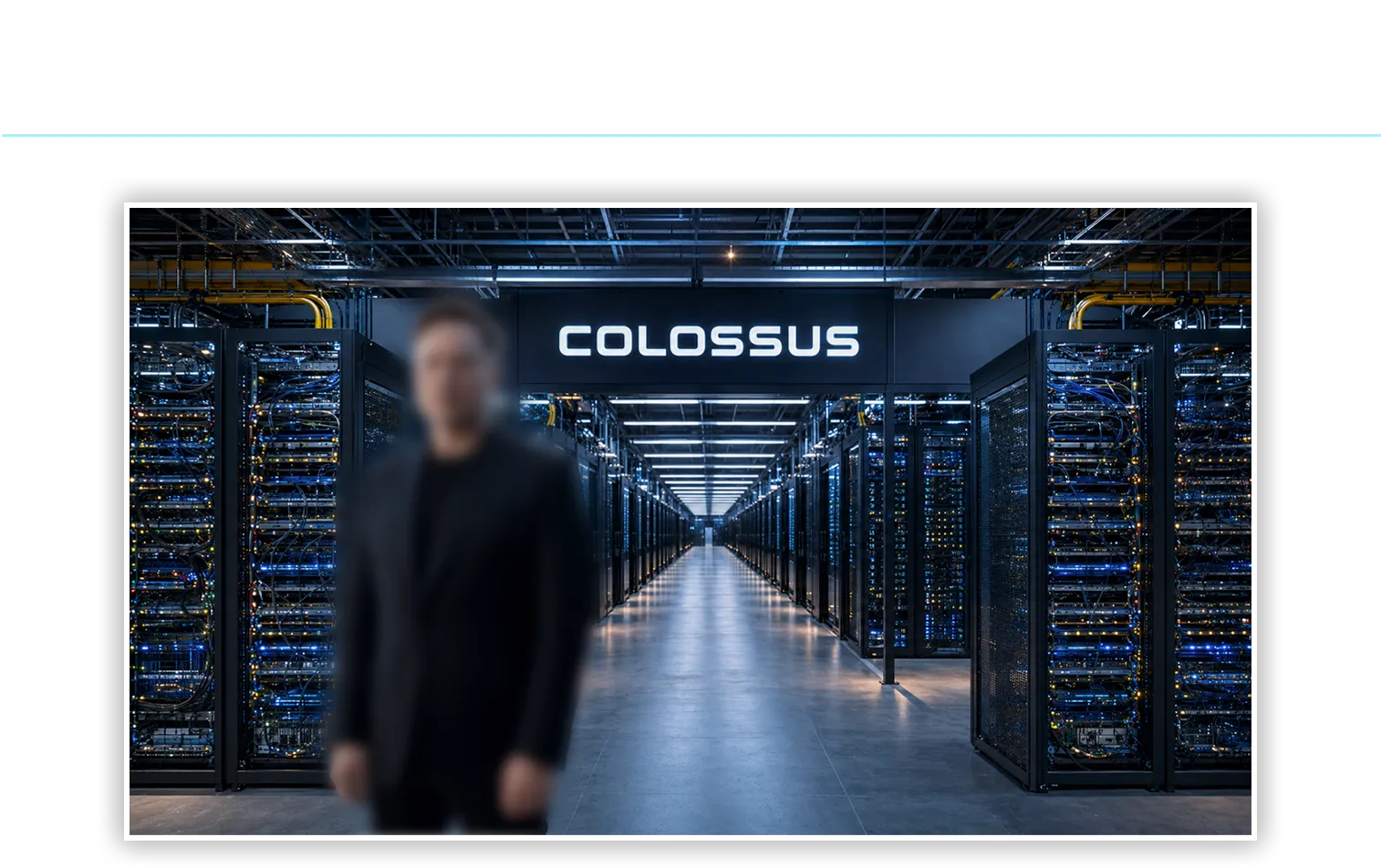
The most recent leg is xAI, which “reached a record $100 billion valuation,” and its physical expression, the Colossus campus, “1,156 acres,” about “1,049 football fields,” drawing roughly two gigawatts to train Grok, which “consistently ranks among the top AI models in independent benchmarks.” On top of it sit the two projects the current Brownstone presentation documents: the $119 billion Terafab semiconductor plant in Texas, “set to be the world’s largest and most advanced chip-making operation,” targeting “up to 200 billion chips per year,” and the FCC-permitted Starmind constellation of “up to one million AI satellites.”
Why the structure matters to investors
Two investment-relevant properties follow from this structure. First, the fortune is a bet on vertical integration across the physical AI stack: chips, power, launch, satellites, compute, models, and, if the Starphone thesis is right, devices. That is why competing analyses keep converging on “own the suppliers to the stack” as the retail-investor expression, since the stack itself is private or concentrated. Second, the fortune is valuation-sensitive: the trillionaire mark, “Elon Musk just became the world’s first trillionaire… at least temporarily,” arrived and receded with the AI trade’s mood, which is why the rotation theses, like Chaikin’s FP64 argument that precision scientific computing redirects part of the AI economy to the DOE supercluster and its suppliers, get framed as trillionaire-at-risk stories. The honest reading: the empire’s diversification is real, and the rotation matters for portfolios, not for the obituary of anyone’s fortune.
Questions readers ask
What are the actual value drivers behind the trillionaire status? The stack runs PayPal, then Tesla, then SpaceX and Starlink, and now the AI layer. Two numbers from the Starphone coverage put the SpaceX piece in perspective: Starlink generates 69% of SpaceX’s revenue, and Google agreed to pay $920 million a month for orbital compute capacity through 2029, a contract worth more than $30 billion. The valuation premium sits on the expectation that the AI layer compounds from there.
Where does the AI layer sit inside SpaceX? Grok now sits inside SpaceX, alongside the Starmind compute-satellite program, and the FCC has accepted Musk’s request to launch up to one million AI satellites. That is a vertically integrated AI infrastructure company, in the Bear Creek-style framing of Jeff Brown’s parallel pitch: chips, satellites, models, and now potentially a device.
Why does the structure matter to investors? Because almost none of it is directly buyable. Tesla is the one public proxy, but the phone, the satellites, and the compute contracts live in private SpaceX, which is exactly why the newsletter industry’s answer is the supplier layer: Qualcomm for satellite chips in Baylin’s Starphone pitch, the inference-hardware name in Brown’s One Stock pitch. Our full review covers the Chaikin side of the Musk map.
Where to learn more
Start with our End of Elon? American Atlas review, then the Starphone supplier thesis and the presenter’s Terafab and Starmind coverage. Chaikin’s full presentation is at the Chaikin Analytics offer page, discounted from $499 with a 30-day refund guarantee.
NewsletterVetter is an independent publication. We receive compensation from some of the services we review through affiliate links. Nothing on this site is investment advice. Always do your own research.