Cerebras Stock: The Inference Chip Story
Cerebras stock is one of the most searched tickers among people who have watched the presenter’s “Elon Musk’s One Stock Retirement Plan” presentation, and for good reason. Brown teases a small “Accelerated AI” company he says owns patented technology “1,000 times FASTER than regular AI,” and when you line up every clue in the presentation, the profile that emerges most closely is Cerebras Systems, which trades under the ticker CBRS. In this article we walk through what Brown actually claims, why our clue analysis points where it does, and what an investor should weigh before acting on any of it. We walk through the specifics in our How to Buy Cerebras Stock: Ticker, Venue, Steps piece.
What the presentation actually claims
Brown, the former senior executive at Qualcomm, NXP Semiconductors, and Juniper Networks who publishes The Near Future Report, keeps the company’s name behind his paywall. But he is unusually generous with checkable details. The teased company:
- Is “as big as Nvidia was in 2016,” before Nvidia’s 37,800% run
- Owns patented technology protected by “this patent you see on the screen… plus 149 other patents”
- Carries “a backlog of more than $24 billion” and is “sold out into 2027”
- Has seen sales grow “about 500% a year since 2022… almost six times faster than Nvidia’s current sales growth”
- Has multi-billion dollar deals, per the presentation, with OpenAI, Microsoft, IBM, AMD, and Amazon
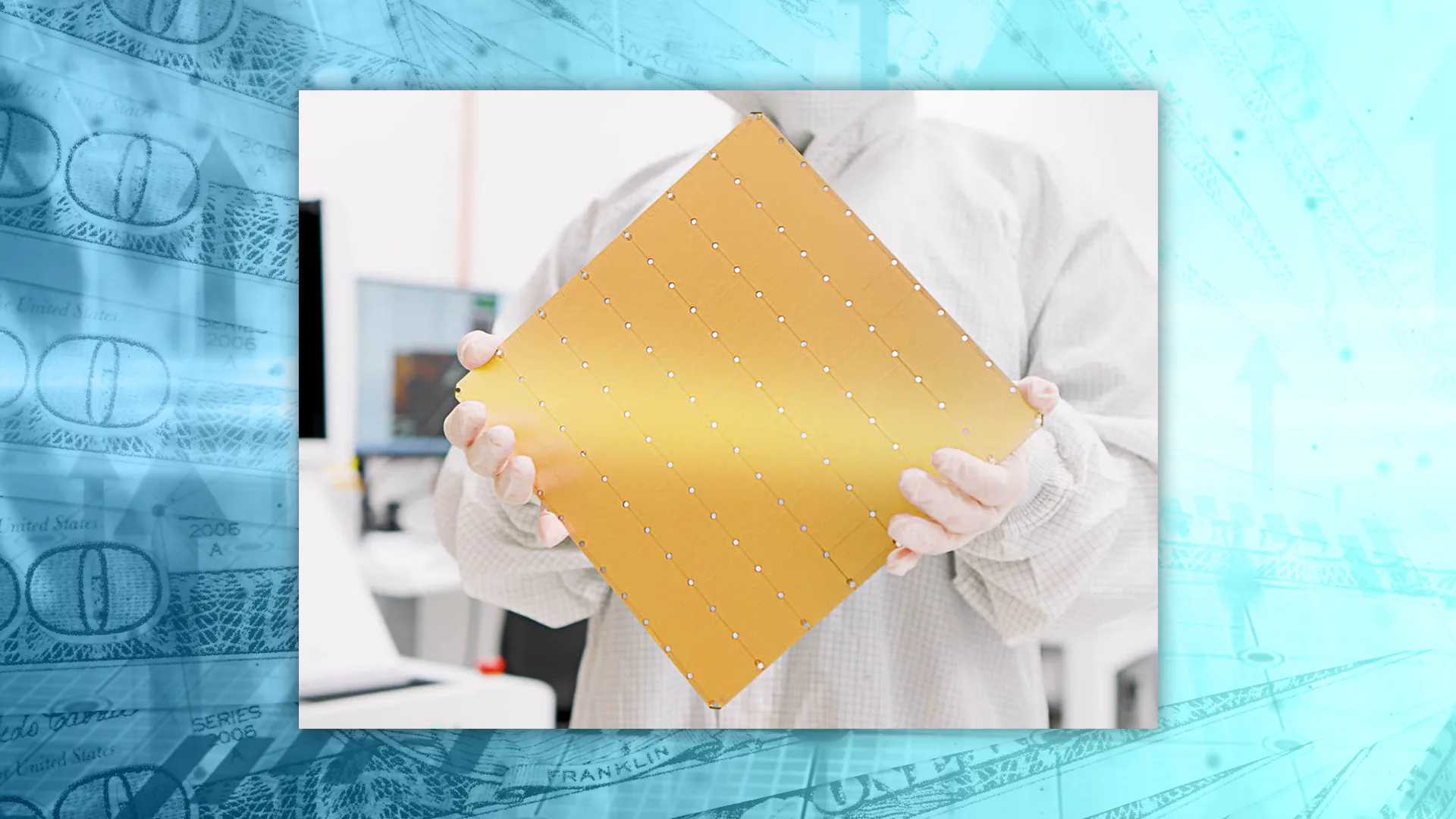
- Sells its product as a physical device Brown calls “this strange golden tablet,” supporting “up to 120 trillion parameters”
Why the clues point to Cerebras
Cerebras is the pioneer of wafer-scale computing. Instead of manufacturing dozens of small chips and wiring them together into a cluster, Cerebras builds a single, dinner-plate-sized chip that puts an enormous amount of compute on one piece of silicon. That matters for the exact problem Brown identifies: latency.
His classroom analogy is worth quoting directly: “It’s like trying to pass a note down a long row of people sitting in a classroom. Every single person who has to take the note and hand it to the next one adds a little delay… That’s called latency in a computing system.” A wafer-scale design removes most of the note-passers. Fewer hops between chips means faster answers, which is precisely the “Accelerated AI” advantage Brown describes for inference, the phase where a trained AI model is actually put to work at speed and scale. For the full side-by-side, see our Cerebras vs Nvidia comparison.
The “golden tablet” form factor, the inference-first positioning, the size profile in the tens of billions, and a business built on licensing patented hardware to the biggest AI buyers all fit Cerebras more cleanly than any other candidate. We want to be clear about what that is and is not: it is our analysis of the teaser’s clues, not a confirmation from Brown or from Cerebras. The presentation never names the company, and Brown has recommended other inference-adjacent names in past teasers. For the full backstory, see our AI Workloads: Training, Inference, and the Hardware article.
The Nvidia comparison
The obvious question is why anyone would need an alternative to Nvidia. Brown’s answer is the training-versus-inference distinction, and it is a genuine industry shift, not just promotional framing. He argues that “most of the investments in AI so far have focused on what I call ‘generic AI.’ And Nvidia was the big beneficiary of that first phase. But the future will be powered by what I call ‘Accelerated AI.’” Training giant models is Nvidia’s fortress. But serving those models to millions of users, in real time, at the lowest cost per answer, is a different workload where an inference-optimized architecture can compete on price-performance rather than raw scale.
His master analogy is the internet transition: “Dial up was ‘slow internet’… Broadband was ‘fast internet.’ And the companies that made that transition possible made their shareholders incredibly wealthy.” Whether inference repeats that pattern is the bet.
The catalyst Brown is pounding the table on
Two Elon Musk-related projects frame his timing. First, a Texas government document confirming Musk is building a $119 billion semiconductor plant called Terafab, which Brown says he has personally visited the site of. Second, an FCC notice accepting Musk’s request to launch “up to one million AI satellites” for a project called Starmind. Brown’s view: these moves turbocharge AI demand, and the inference company gets the overflow.
The nearer catalyst is commercial. “Executives of this company have promised that they’ll begin to deploy this technology through Amazon’s network very soon,” he says, and he expects the details to surface on an analyst call, framed against a “before November 11” deadline. Dated deadlines in newsletters deserve healthy skepticism; the underlying AWS relationship is the checkable part.
Considerations before buying Cerebras stock
The honest risks: Nvidia is not standing still, and hyperscalers design their own inference silicon too. The “1,000 times faster” and “2,000 times more powerful than Nvidia’s” claims are the presenter’s characterization of a performance advantage, not verified benchmarks. A newly public semiconductor company can be volatile, and a teaser-driven stock can run ahead of fundamentals. Brown himself hedges the concentration pitch sensibly: “I’m not recommending folks put their entire savings in this one stock. I would never do that with my money.”
For context on his track record, The Near Future Report discloses an average gain since inception of 39.4%, alongside big calls like Nvidia in 2016 and peak gains of 1,700% in Arista Networks.
Where to get the actual name
If you want Brown’s specific ticker and analysis, it is in his report “The One-Stock Retirement Plan,” included with a $179 trial of The Near Future Report, backed by a 30-day full-refund guarantee that lets you keep the reports. For more background first, see our review of Brown’s prior Musk pitch, the 10X Project, our profile of The Near Future Report, and our the presenter presenter profile.
NewsletterVetter is an independent publication. We receive compensation from some of the services we review through affiliate links. Nothing on this site is investment advice. Always do your own research.