AI Workloads: Training, Inference, and the Hardware
AI workloads are the actual jobs computers do for artificial intelligence, and the word matters for investors because different jobs reward different hardware. The two dominant AI workloads are training, building a model by processing enormous datasets, and inference, running that model to produce answers. the presenter’s “Elon Musk’s One Stock Retirement Plan” presentation is essentially an argument that the balance of spending is shifting from the first workload to the second, and that the shift creates a new winner. Here is the plain-English version. For the full backstory, see our Cerebras (CBRS) Stock Price: What Drives It article. We break down that angle in our Training vs Inference: Why the Distinction Matters piece.
The two workloads, defined
Training is construction. Thousands of processors run for weeks, tuning a model’s parameters against mountains of data. The metric that matters is throughput: calculations per second, because the faster you train, the more experiments you can run and the bigger the model you can afford to build. Clusters of GPUs dominate this workload, which is why Nvidia, as Brown says, “was the big beneficiary of that first phase” of AI.
Inference is operation. A trained model answers requests: writing text, flagging fraud, routing calls, coding. Brown’s compact definition: “It simply means we’re running intelligence at speed and scale.” The metrics that matter shift here: latency (how fast one answer comes back) and cost per answer, because every request burns money in proportion to its compute time.
Why inference changes the hardware math
During training, a job runs for weeks and nobody is waiting. During inference, a human or a machine is waiting, and speed is the product. The bottleneck is that models are too big for any single chip, so the work is split across many of them, and the chips must talk constantly. Every hop between chips adds delay. Brown’s classroom analogy is the clearest explanation we have seen in any newsletter presentation: “It’s like trying to pass a note down a long row of people sitting in a classroom. Every single person who has to take the note and hand it to the next one adds a little delay… That’s called latency in a computing system.”
For a chip designer, there are two ways to attack that: make the inter-chip links faster (the networking approach, where companies like Broadcom and Astera Labs play) or shrink the distance by putting more compute on one piece of silicon (the wafer-scale approach, associated with Cerebras, which our clue analysis matches to the company Brown teases). Brown, a former senior executive at Qualcomm and NXP, frames it as a 75-year-old problem: “Nobody had been able to figure this out… Until now.”
Why the mix is shifting toward inference
Brown’s pitch hangs on a transition he names: “Most of the investments in AI so far have focused on what I call ‘generic AI’… But the future will be powered by what I call ‘Accelerated AI.’” Three forces push spending toward the inference workload:
- Usage grows on its own once models ship. Every user, every agent, every automated process adds a permanent stream of inference demand, while training spend is project-based and finite.
- Agents make it worse, in a good way. AI that acts continuously, checking, deciding, executing, multiplies inference calls per user far beyond chat. Brown cites partners using the teased company’s technology for exactly these: OpenAI making “ChatGPT respond much faster,” CrowdStrike enabling “real-time AI security,” Microsoft helping “software engineers write code faster.”
- Real-time products demand low latency or they do not work. A coding assistant that takes 30 seconds per keystroke has no product, regardless of how smart the model is.
The financial profile Brown attributes to the inference company: sales growing “about 500% a year since 2022… almost six times faster than Nvidia’s current sales growth,” a “backlog of more than $24 billion,” and capacity “sold out into 2027.” He anchors demand to Elon Musk’s Terafab chip plant and Starmind satellite constellation, with an AWS deployment as the near catalyst.
Considerations
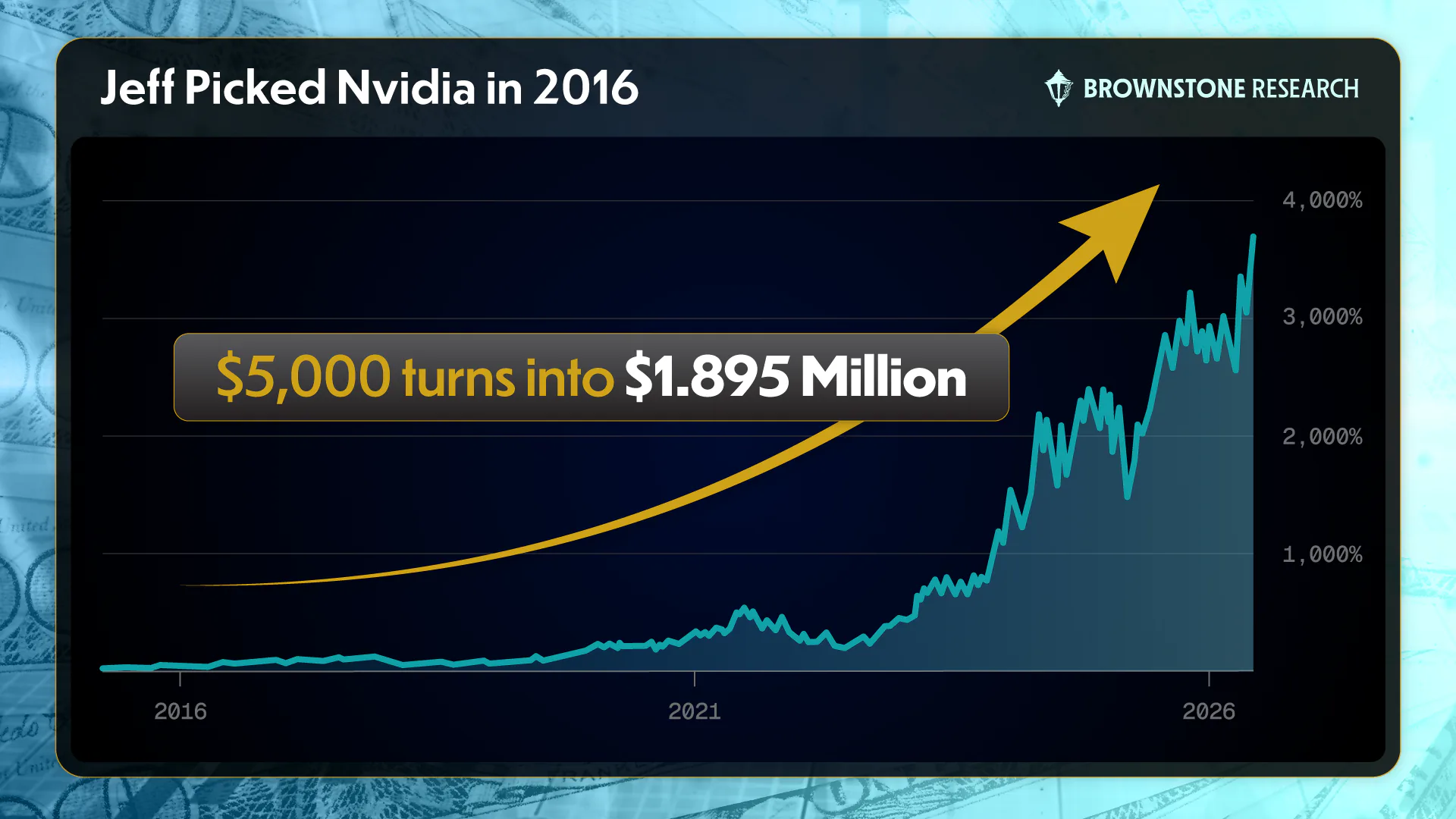
The workload-shift thesis is real, but two cautions belong here. Throughput and latency are not enemies; Nvidia’s roadmap pushes both, and hyperscalers build custom inference silicon of their own. And “1,000 times FASTER than regular AI” is Brown’s characterization of an architectural advantage, not a verified benchmark. The durable question for any investor: which companies get paid as usage, not training, becomes the center of AI spend? Brown’s own service discloses a 39.4% average gain since inception, a fair anchor against the 37,800% Nvidia headline.
Where to learn more
Brown’s specific pick and ticker are in “The One-Stock Retirement Plan,” included with a $179 trial of The Near Future Report, backed by a 30-day keep-everything refund guarantee. For background, read our review of Brown’s 10X Project pitch, the Near Future Report profile, and our the presenter presenter profile. For the memory side of the AI hardware stack, our HBM memory explainer covers the other bottleneck in the pipeline.
NewsletterVetter is an independent publication. We receive compensation from some of the services we review through affiliate links. Nothing on this site is investment advice. Always do your own research.