What Is Physical AI? Plain Terms, Real Examples
Physical AI is the shift from artificial intelligence that lives on a screen to artificial intelligence that acts in the real world: robots, autonomous vehicles, satellites, and devices that sense, decide, and move. The term has been popularized by analysts including Josh Baylin, whose “Starphone” presentation for Stansberry Research’s True Innovations Report calls a satellite-connected AI phone “the first truly physical AI device of its kind.” This article explains what the term means, why investors are hearing it now, and what the real examples are. We break down that angle in our Physical AI Stocks in 2026: Josh Baylin’s Thesis piece.
The definition, without jargon
Most AI you interact with today is software in a data center: you type, it answers, nothing in the physical world changes. Physical AI closes that loop. It pairs intelligence with sensors and actuators, so the system can perceive its environment and act on it. A chatbot writes you a poem. A physical AI system flies a drone, drives a forklift, points a satellite, or routes a phone call through space in real time.
Baylin’s presentation leans on the device side. The Starphone thesis describes a phone that is “usable worldwide without cell towers… running on one of the most powerful AI-based platforms in existence,” where the intelligence lives in the network above your head. Musk’s own framing, quoted in the presentation from his Joe Rogan appearance: “I don’t think there’ll be operating systems. I don’t think there’ll be apps. The phone will just display the pixels and make the sounds.” That is physical AI in miniature: the device becomes a sensor and display, the thinking happens elsewhere.
Real examples you already know
The concept is easier to judge with concrete cases, and several are already in the market:
- Satellite connectivity. Starlink’s Direct to Cell service, live with T-Mobile, lets ordinary phones reach satellites as if they were cell towers. Qualcomm and MediaTek are building satellite connectivity into future phone chips; Baylin’s free pick is Qualcomm (QCOM) for exactly this reason: “there’s a real chance it runs through Qualcomm’s satellite chip.”
- Autonomous vehicles. Tesla’s self-driving effort is physical AI by definition, and Musk calls the car “a robot on wheels.”
- Orbital data centers. SpaceX has unveiled its AI1 compute satellite, “the wingspan of a Boeing 747,” running “somewhere around 120 to 150 kilowatts of computing power” on sunlight alone. Google, per the presentation, “agreed to pay SpaceX $920 million a month for SpaceX computing capacity” through 2029, a contract worth more than $30 billion.
- Robotics. The humanoid robot push, which our MAGI coverage has tracked across several Musk-themed presentations, is the industrial expression of the same trend.
Why the term is showing up in stock pitches now
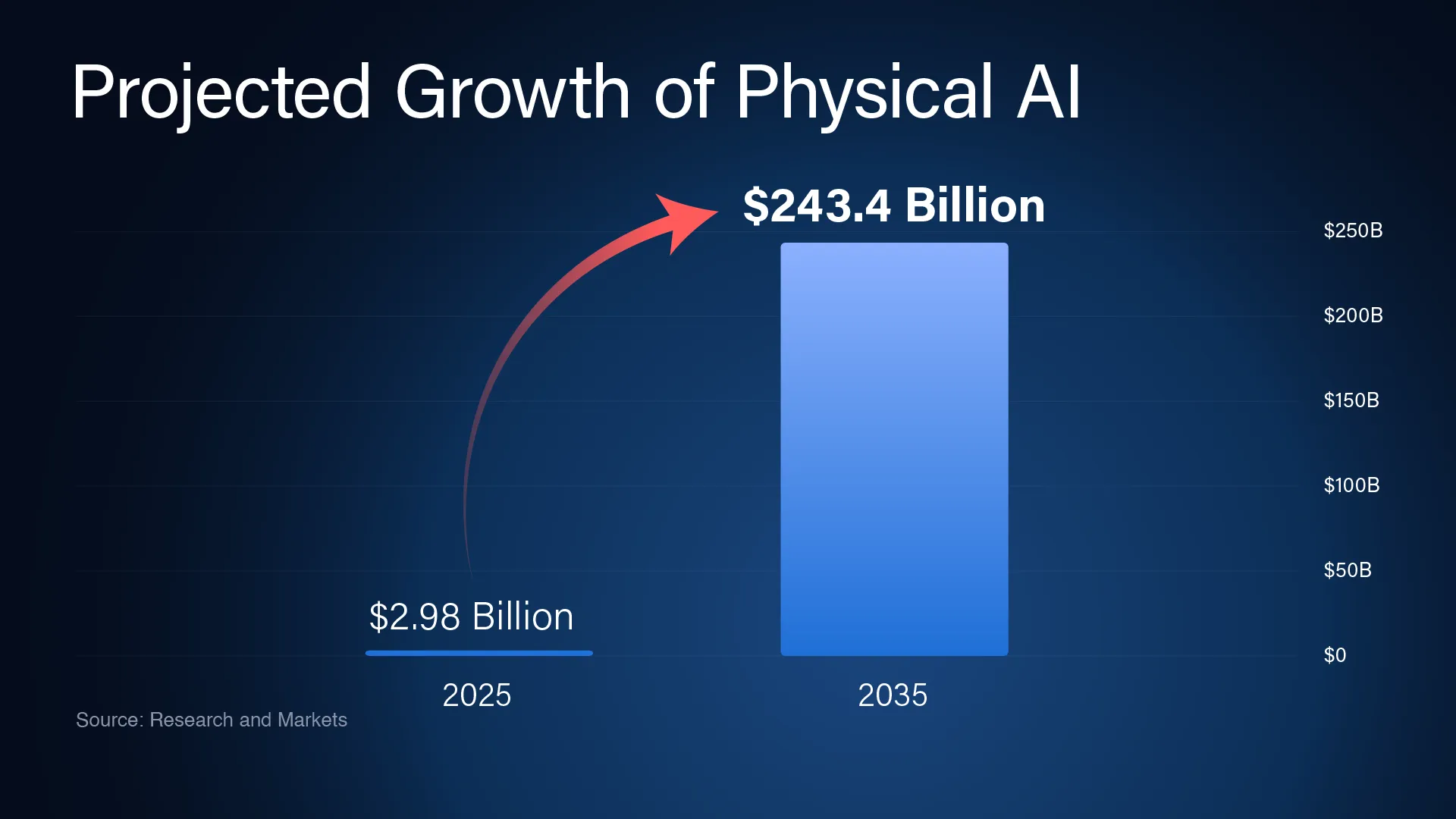
Baylin’s line is direct: “Physical AI is going to be one of the defining wealth-building trends of the next few years.” The reason is economic rather than literary. The first phase of AI, training giant models, mostly benefited a handful of chip and cloud companies. The next phase, deploying intelligence into devices and infrastructure, has a far broader supply chain: satellite makers, radio-frequency chip companies, machine-vision specialists, battery and thermal suppliers. Baylin’s bonus report “Your Financial Guide to the Physical AI Boom” targets exactly these, including a satellite-communications veteran that “hikers, sailors, pilots… have all relied on for years,” and a machine-vision company with “over twenty years allowing technology to ‘see.’”
His historical framing is the smartphone supply chain: names like Skyworks went “up as much as 491%” and Cirrus Logic “as high as 489%” riding the last device transition. The claim is that physical AI repeats the pattern at larger scale, with his headline figure of “50 times their money by the time Starphone launches, if you own the right stocks.”
Considerations
Two honest cautions. First, terminology can outrun reality; a satellite-connected phone is a real product category, but “physical AI” is a label publishers use to make it feel like a new era. The underlying component businesses, satellite comms, RF chips, vision systems, are real but cyclical, and many trade with semiconductors’ boom-bust rhythm. Second, the Starphone itself remains unconfirmed by Musk, who called the phone reports “utterly false,” though Baylin’s reading of the filings, trademarks, the $17 billion EchoStar spectrum purchase, and the FCC’s new licensing rules is that the groundwork is all in place.
Where to learn more
Baylin’s physical AI report and supplier list come with a trial of the True Innovations Report, backed by a 30-day full-refund guarantee. For related reading, see our coverage of Oxford’s take on Musk’s secret phone partner, orbital data centers as a theme, and edge AI stocks from our Ambient AI coverage, which covers the on-device intelligence trend from another publisher’s angle.
NewsletterVetter is an independent publication. We receive compensation from some of the services we review through affiliate links. Nothing on this site is investment advice. Always do your own research.