AI Black Paper Review: Is Jim Rickards’ Strategic Intelligence Worth It?
Jim Rickards’ “AI Black Paper” is a fear-driven macro presentation that argues the AI stock bubble is about to burst in a “Minsky Moment” that could crash the market by 80%. The former CIA and Pentagon advisor makes a sophisticated, well-sourced case that AI companies are burning cash, engaging in circular financing schemes reminiscent of the dotcom era, and securitizing data center debt in structures that echo the 2008 subprime CDO crisis. Whether or not you agree with his crash timeline, the analysis is worth understanding.
The Presenter
Jim Rickards is one of the most credentialed figures in the financial newsletter industry. He served as an advisor to the CIA and Pentagon, and he was called in to help negotiate the bailout of Long-Term Capital Management (LTCM) in 1998, a crisis he describes in detail: “they called me in to help negotiate a bailout with the Fed. In fact, in the book When Genius Failed they detail the whole story, plus the five long days I spent on the phone with the Federal Reserve. We likely saved the U.S. economy that day.”

His track record includes some impressive calls. In 2006, two years before the subprime meltdown, he sent a warning to intelligence officials in Washington about a looming financial crisis. The CIA circulated his thesis among its senior staff, and it appeared in the CIA’s official journal, Studies in Intelligence. He then testified before Congress in 2007 and supplied the Treasury Department with a plan to avert the crisis. Three weeks later, Lehman Brothers collapsed.
His team also claims to have warned readers about the Covid crash three weeks before it began, and to have published a thesis about a coming pandemic four months before the first reported case. He says his team helped subscribers achieve gains as high as 468% during the 2008 financial crisis by recommending specific bank stocks as the sector collapsed.
Rickards founded Strategic Intelligence roughly 15 years ago, focusing on complexity theory, geopolitical shifts, and capital flows. He claims less than 10 people in the world know how to properly apply complexity theory to financial markets, which positions his analysis as genuinely unique.
His political track record includes predicting Brexit in 2016, Donald Trump’s victories in both 2016 and 2024, and the Ukraine war. These are harder to verify with specific timestamps but add to the overall credibility narrative.
The Big Idea
The core framework of the AI Black Paper is the “Minsky Moment,” named after Harvard economist Hyman Minsky. Rickards explains it as a four-phase process:
- Hedge Finance Phase: Companies take on debt they can repay from cash flows.
- Speculative Phase: Companies take on more debt than earnings can cover.
- Ponzi Phase: Companies need new investors just to service existing debt. “They need new investors just to keep up with debt repayment.”
- Minsky Moment: “Investors finally catch on and the market suffers a massive collapse.”
Rickards maps this framework to the current AI boom with several compelling arguments:
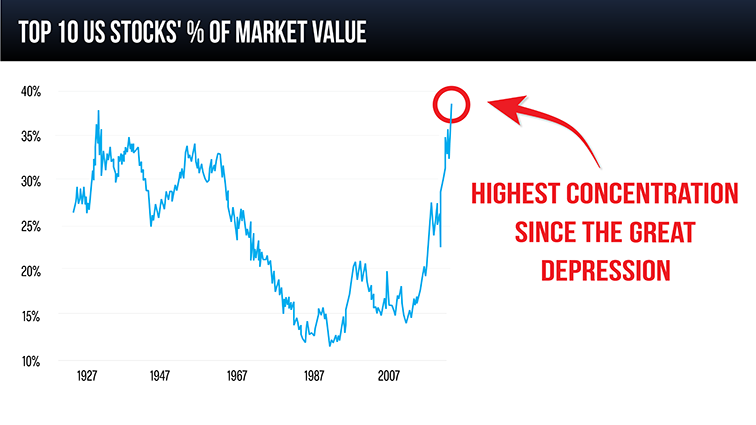
AI companies are burning cash at unprecedented rates. OpenAI is losing more than a billion dollars a month. For every dollar they make, they spend at least three. Deutsche Bank estimates OpenAI will need to accumulate $143 billion in negative cash flow before making a single dollar in profit. Sam Altman himself once admitted: “I have no idea how we are going to generate revenue.” Yet the company plans to IPO for nearly a trillion dollars.
Circular financing is creating an illusion of demand. Rickards draws a direct parallel to Lucent Technologies during the dotcom bubble. Lucent lent billions to cash-strapped customers to buy its equipment, booked the sales as revenue, and created what Rickards calls “a feedback loop that cooked their books.” Today, he argues, Nvidia is investing in startups that then buy Nvidia’s chips, while OpenAI invests in Oracle’s data center buildouts that then invest back in OpenAI. Grace Blakeley, a research fellow, called it “the central bank of AI and the lender of last resort.”
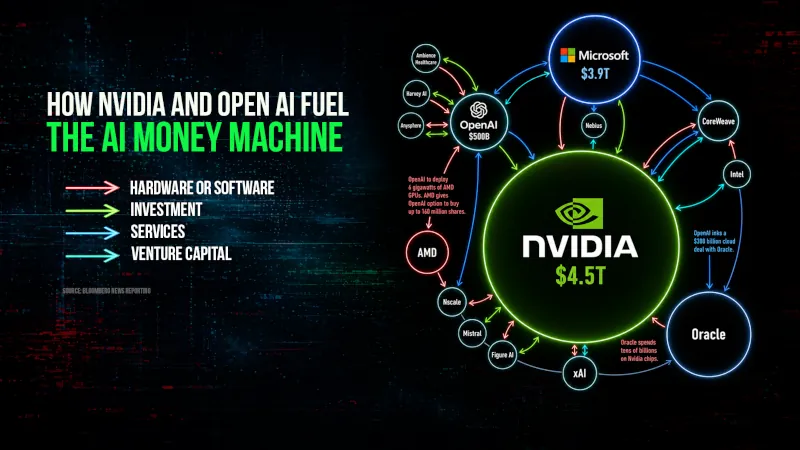
Data center debt is being securitized like subprime CDOs. This is perhaps the most provocative claim. Rickards argues that private equity funds build data centers, charge AI companies rent, and then combine multiple leases into securities sorted into “tranches” based on default risk, exactly like the CDO structure that caused 2008. Charlie Warzel of The Atlantic confirmed this: “Private-equity firms put up or raise the money to build a data center, which a tech company will repay through rent. Multiple data-center leases can be combined into a security.”
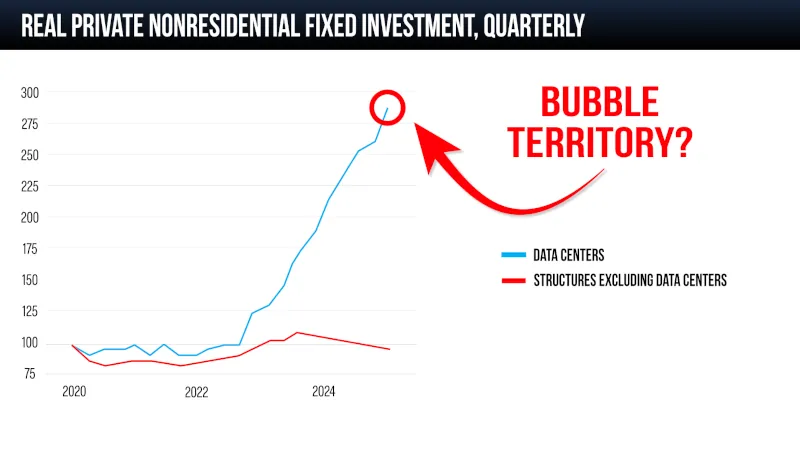
AI is hitting physical limits. Rickards cites Tim Dettmers of Carnegie Mellon: “Rack-level optimization will likely hit the physical wall in 2026 or 2027.” Marc Andreessen says AI is “hitting a wall.” Yann LeCun, Meta’s chief AI scientist, calls LLMs “a dead end.” Gary Marcus says “scaling is running out, and that truth is, at last coming out.”
Smart money is already exiting. Stanley Druckenmiller sold all his Nvidia and Palantir shares. Peter Thiel sold his entire Nvidia stake. Michael Burry made a $1.1 billion bet against AI. These are documented moves by billionaire investors who have previously predicted major market turns.
Rickards also makes an important psychological argument about why most investors will miss the coming crash. He calls it “extrapolation bias,” the tendency to assume the future will look like the recent past. “People believe that because something has happened in the recent past, it’s likely or even inevitable that it’s going to happen in the future. And it makes even the highest IQ people deny a pending disaster, no matter how obvious the danger may be.” He references his experience negotiating the LTCM bailout, where Nobel Prize winners with 150+ IQs managed a fund built on models that “assumed the future would look a lot like the past” and nearly blew up the entire U.S. economy.
The key intellectual contribution here is the “subprime AI” concept. Rickards argues that data center financing is following the exact CDO blueprint from 2008: private equity funds the construction, AI companies pay rent, and multiple leases get bundled into tranches and sold to pension funds and retirement accounts. David Dayen of The American Prospect put it this way: “We have a 2000s housing bubble level of financial engineering on top of a 1920s level of private unregulated lending on top of something bigger than a 1990s internet level of technology and infrastructure build-out.” Oliver Wyman, a top financial consulting firm, warned that “an equity crash like the early 2000s would wipe out approximately $33 trillion of value, more than U.S. GDP.” Whether or not you accept the crash thesis, the structural concern about data center debt is worth understanding.
The Key Claims
The specific claims include:
- “We believe as soon as August 26th at 6:30 PM the U.S. stock market will suffer a major, major collapse”
- The crash will be “more devastating than the 2008 financial crisis, the COVID crash, or even the dotcom collapse combined”
- “The market could fall by as much as 80%”
- “The AI bubble is now 17 times larger than the dotcom bubble”
- “Three-quarters of gains in the S&P 500 since the launch of ChatGPT came from AI-related stocks”
- A “portfolio insurance” strategy that “could soar as high as 600% or more over the next 12 months as the market collapses”
- Rickards has “invested over a million dollars of his own money in preparation for this kind of crisis”
- “Trump’s AI Arsenal” report: “How Investing in A.I. Superweapons Could Turn $1,000 into $162,000”
The August 26th date is presented with striking precision. Rickards explains it is when AI companies like Nvidia, Meta, and Coreweave release their earnings statements, and “a single earnings miss could be the pin that pricks the bubble for AI.” The date is real (it is an earnings date), but the implication that it will trigger an 80% crash is speculative.
Rickards draws a direct historical parallel to March 20, 2000, when Barron’s published an article called “Burning Up” warning that at least 50 dotcom companies would run out of money within 12 months. Within a week, stocks began to crater. Pets.com, which had IPO’d just one month earlier, plummeted 67% within a month and was bankrupt within nine months. The Nasdaq eventually crashed nearly 80% and didn’t recover for 15 years. Rickards also points to September 28, 2007, when NetBank collapsed, marking the beginning of the subprime mortgage cascade. “The Minsky Moment always takes everyone by surprise. One day the market is beginning to soar. The next day, a single sobering report comes out and reality sets in.”
The claims are hedged with “we believe,” “according to our best estimates,” and “my guess is.” Rickards also offers a fallback: “And even if I’m wrong, well, that’s the best part. I think you’ll still make very good gains. Even if the AI bubble collapse looks more like a correction than a crash, you’ll still be set up to do very, very well.”
The Free Ticker
Unlike most promos in this space, the AI Black Paper does not give away a free stock pick before the paywall. Rickards names several stocks as examples of the bubble (Nvidia, Palantir, OpenAI, Oracle) but does not recommend any of them. The actual investment recommendations are locked inside the six reports that come with the subscription.
The closest thing to a free insight is Rickards’ five-step action plan: (1) exit stocks most exposed to the AI fallout, (2) invest in assets that surge when AI collapses, (3) purchase “disaster insurance” that pays out more the greater the collapse, (4) hold physical gold, and (5) prepare your home for civil unrest. The specific tickers for each step are in the reports.
What You Get
The offer includes:
- 6 months (6 issues) of Strategic Intelligence newsletter
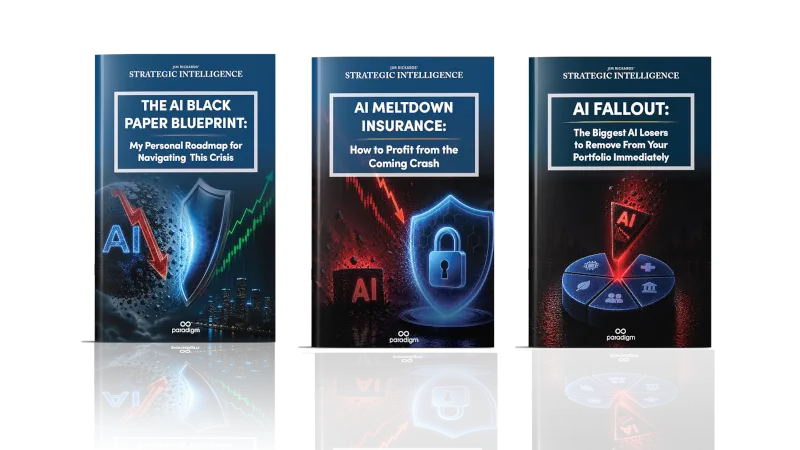
- Special Report #1: “AI Fallout: The Biggest AI Losers to Remove From Your Portfolio Immediately”
- Special Report #2: “The AI Black Paper Blueprint: My Personal Million-Dollar Roadmap for Navigating and Profiting From This Crisis”
- Special Report #3: “AI Meltdown Insurance: How to Profit from the Coming Crash”
- Bonus Report #4: “Trump’s AI Arsenal: How Investing in A.I. Superweapons Could Turn $1,000 into $162,000”
- Bonus Report #5: “The Perfect Physical Gold Portfolio”
- Bonus Report #6: “How to Make Your Home Your Personal Fortress” (by former CIA operative Jason Hanson)

The price is $49 for 6 months (originally $299, an 83% discount). That works out to about $8 per month. The guarantee is 3 months: “You’ll have three full months to decide if this research is right for you. If you don’t like what I have to offer, for any reason whatsoever, just call my customer service team and we’ll refund you the full cost.” You keep all reports even if you cancel.
The guarantee period is shorter than some competitors (BTM Gold War offers 6 months), but 3 months is enough time to evaluate several issues.
Our Take
The AI Black Paper is one of the most intellectually sophisticated financial newsletter promos we’ve reviewed. Here is what stands out:
The Minsky Moment framework is a legitimate economic theory. Rickards is not inventing a concept here. Hyman Minsky’s financial instability hypothesis is well-known in academic economics, and mapping it to the AI boom is a thoughtful exercise.
The circular financing comparison to Lucent is apt. Vendor financing during the dotcom bubble is a well-documented phenomenon. Nvidia’s investments in AI startups that buy Nvidia chips is a real pattern that deserves scrutiny. Whether it constitutes “the illusion of demand” is debatable, but the comparison is intelligent.
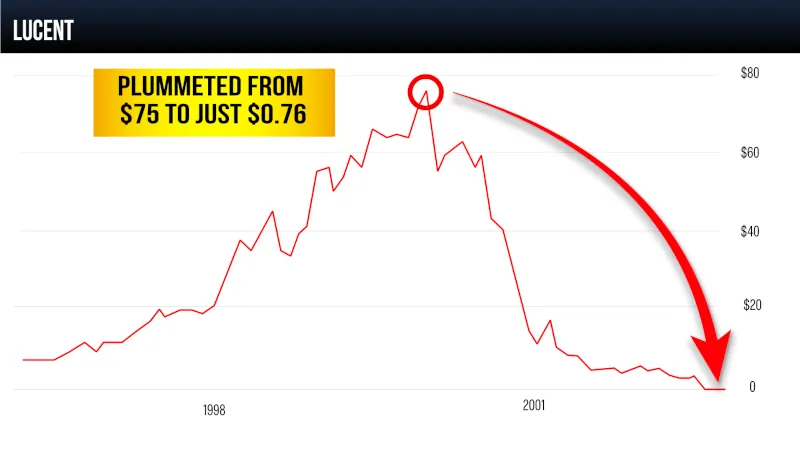
The data center CDO comparison is the most provocative claim. The idea that data center lease payments are being securitized into tranches, bought by pension funds, and backed by an industry that produces minimal profits is genuinely concerning. The Atlantic and Oliver Wyman sources Rickards cites are real, and the parallel to 2008 is worth taking seriously.
Rickards’ CIA and LTCM background gives him genuine authority. Few newsletter publishers can claim to have negotiated a bailout with the Federal Reserve or had their analysis circulated by the CIA. This is not manufactured credibility.
What to consider: The August 26th date is an earnings date, not a confirmed crash date. The 80% crash prediction is extreme even by bear-market standards. The promo does not engage with bullish AI arguments (enterprise adoption, productivity gains, revenue growth at companies like Microsoft and Google). And the six-report package is broad, spanning financial recommendations to home security, which may feel scattered to some investors.
We recommend this for investors who want a structured bear case for AI stocks and actionable protection strategies. Rickards’ analysis is genuinely thought-provoking, and the $49 price with a 3-month guarantee makes it low-risk to evaluate. Even if you disagree with the crash thesis, understanding the bear case will make you a better investor.
Where to Learn More
- For the bullish counterargument on AI, see our Accelerated AI review covering how photonics could 100x data center speeds.
- For a gold-focused macro thesis, see our BTM Gold War review covering Dylan Jovine’s case for a third gold revaluation.
- For more on dollar devaluation, see our Stansberry End of Dollar Reboot review.
- See our Paradigm Press publisher profile for more on the publisher behind this promo.
- Have a promo you want us to vet? Submit it here.
- Ready to try Strategic Intelligence? Click here to learn more.
NewsletterVetter is an independent publication. We receive compensation from some of the services we review through affiliate links. Nothing on this site is investment advice. Always do your own research.