BTM Gold War Review: Is Behind the Markets Worth It?
Dylan Jovine’s “BTM Gold War” is one of the most thoroughly researched financial newsletter promotions we’ve analyzed this year. The core thesis is that the United States is preparing for a third historic revaluation of gold, and that Washington has already begun financing a single American gold mining company to serve as a strategic asset in a monetary war with China. It is a bold claim, but Jovine supports it with an impressive array of federal filings, executive orders, and documented government actions that are worth understanding regardless of whether you ultimately subscribe.
The Presenter

Dylan Jovine is not a typical newsletter pitchman. He built his own broker-dealer at 100 Wall Street by age 24, which he describes as “one of the youngest broker-dealers in history.” He grew up in Queens, standing in line for food stamps, and worked his way into Wall Street despite being, in his words, “laughed out of every Ivy-League-filled room.”

His track record is genuinely impressive and documented. A full year before Lehman Brothers collapsed, he issued a public warning on June 9, 2006: “The market has no place else to go but down. It’s not a question of ‘if’ it’s a question of ‘when.’” That call got him invited to meet privately with President George W. Bush and Vice President Dick Cheney.
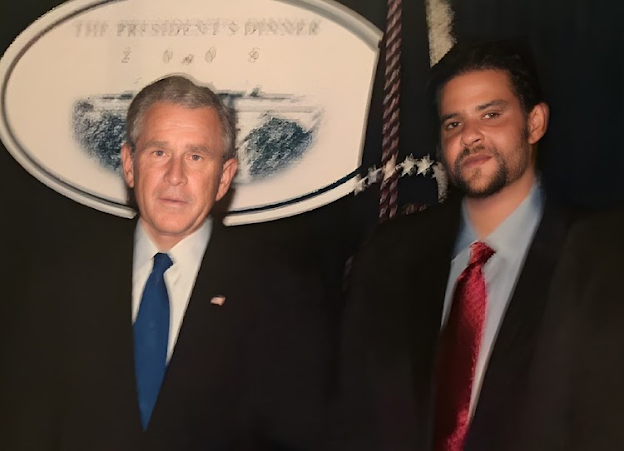
When the Dow dropped 54%, he went on CNBC calling the bottom, telling listeners that a stock market at 6,500 was like “walking into a dealership where everything is marked 90% off.” Anyone who followed that call had the chance to book gains like 459% on AutoNation, 646% on American Express, and 700% on Starbucks. In March 2020, he called the Covid crash bottom almost to the day.
More recently, he recommended Palantir at around $7 a share, recognizing it as “a national weapon, the data platform the U.S. military, the spy agencies, and the CIA physically could not operate without.” The stock ran as high as $207, a gain of over 2,857%. He also recommended gold at $1,800 in 2021, and it has since more than doubled to around $4,000.

Across eight years and every closed recommendation, winners and losers combined, Jovine reports a 71% win rate and a 40% average return. Three out of four calls correct for nearly a decade is a track record worth taking seriously.
He also has unusual access for a newsletter publisher. He met privately with Congressmen Bill Huizenga and Brett Guthrie on March 2nd, was invited to sit down with Donald Trump Jr. at The Breakers in Palm Beach, and even had the Chinese Communist Party send someone to “talk to” him after he exposed links between American technology and China’s military buildup. He reported the contact to federal authorities and kept publishing.
The Big Idea
The central thesis of BTM Gold War is that the U.S. dollar has operated on two historical anchors, both of which are now failing, and that a third “gold rewrite” is underway to reestablish monetary stability.
Anchor 1: Gold (1944-1971). After World War II, the U.S. held two-thirds of all monetary gold on Earth. That gave the dollar its throne. By 1971, the hoard had drained, and Nixon closed the gold window.
Anchor 2: Oil/Petrodollar (1971-present). A handshake with Saudi Arabia made the dollar the mandatory currency of global energy trade. For 50 years, this arrangement let America borrow $39 trillion. Then in February 2022, the U.S. froze roughly $300 billion of Russia’s central bank reserves, and every finance minister on Earth learned the same lesson: “Money parked in the American system isn’t yours. It’s a permission slip.”
Jovine argues that China is now executing a four-move escape from the dollar system: dumping U.S. Treasury debt (from $1.32 trillion to roughly $659 billion), hoarding gold for 20 straight months, hiding the true count (Goldman Sachs estimates 4.8 times the official figure), and building a parallel gold pricing system in Shanghai denominated in yuan.
The counterattack, according to Jovine, is already underway through six documented government moves over 14 months: an executive order designating gold a strategic mineral, BLM land clearances, Fed revaluation research, a Senate gold audit bill, a nearly $3 billion EXIM Bank loan for a gold mine, and federal filings containing the phrase “substantial support and partnership from the Department of War.”
The key concept Jovine introduces is the “96-to-1 gap”: the U.S. values its 261.5 million ounces of gold at the statutory price of $42.22 per ounce (set in 1973 and never updated), giving a book value of about $11 billion. At today’s market price, that same gold is worth over $1 trillion. That is a 96-to-1 gap between the book value and the real value.

Historically, when Washington has revalued gold, the effects were dramatic. In 1934, FDR’s Gold Reserve Act revalued gold from $20.67 to $35 overnight, and Homestake Mining rose 474% while the Dow collapsed 73%. In the 1970s rewrite, gold went from $35 to $850 (a 2,329% rise), and one junior miner, Copper Lake, returned more than 10,000%.
Jovine also frames the urgency around what he calls “The Board Only One Side Can Win.” The argument is that China has committed its monetary escape to gold, and the U.S. holds 8,133 tonnes of gold, more than Germany and Italy combined, and three and a half times what China officially admits to owning. “Your rival just bet its monetary survival on an asset you dominate more completely than any nation has ever dominated anything. What do you do? You don’t fight the gold war. You end it.” The claim is that Washington will force the contest onto the metal, where America’s lead is untouchable, and chain the dollar to gold before China finishes its escape.
This is the intellectual core of the pitch: it is not just that gold will go up, but that the U.S. government has both the motive and the means to revalue gold upward, and that the process has already begun in signed documents and approved financings. Whether or not a formal “rewrite” happens, the accumulation of federal actions around gold mining is real and documented.
The Key Claims
The specific claims in this presentation include:
- “I believe one tiny gold stock is now the absolute prime candidate for America’s next strategic investment, and perhaps the single most important deal of all.”
- Gains “as high as 10,000%” based on historical precedents, with the example “$5,000 to $505,000”
- “$1,000 stake into as much as $100,000 in just a few years”
- The recommended company is “roughly one-fiftieth the size of Newmont”
- The EXIM Bank financing package “eclipses its own actual market cap”
- The company’s federal filings contain “substantial support and partnership from the Department of War”
Jovine also reveals that John Paulson, the hedge fund manager famous for “the greatest trade in history” (his bet against the housing bubble that made his fund roughly $15 billion), has invested approximately $185 million in this company. Paulson installed his longtime partner as chairman of the board and recently added $100 million at $13.20 per share. His stake is roughly a third to half the entire company.

When Reuters asked Paulson why he went this deep into gold, he said: “When the war started, Russia’s physical gold stayed safe, but all their cash, the paper reserves, were confiscated.”
The claims are hedged with “I believe,” “my research says,” and “forward-looking estimate, not guaranteed.” The 10,000% figure is drawn from a historical outlier (Copper Lake in the 1970s), and Jovine acknowledges it is not guaranteed. But the supporting evidence is unusually well-documented for a newsletter promo.
Jovine also makes a point about the government’s recent track record of buying direct stakes in companies. He documents that the federal government has become a direct shareholder in 26 companies over the past 18 months, with $23.9 billion deployed and $205 billion authorized. The pattern is striking: MP Materials surged 226% after the Pentagon announced it was becoming the largest shareholder. Trilogy Metals jumped 402% in a week after Washington bought in at $2.17. Intel soared over 500% after the government converted $8.9 billion into a 9.9% stake. “When this machine picks a company, the stock doesn’t drift higher. It gaps,” Jovine says. The implication is that if the government takes a similar position in the Arsenal, the stock could gap dramatically.
The Free Ticker
Before asking for a subscription, Jovine gives away a free stock pick: Kinross Gold (KGC).
Kinross is one of the largest gold producers operating on American soil, with operations in Nevada and Alaska. Jovine notes the poetic detail that Kinross’s flagship American operation is “a massive Alaskan gold mine literally named Fort Knox.”
The pitch is straightforward: Kinross trades near 12 times earnings (roughly half the market average), the metal it produces sells near $4,000 an ounce, and Wall Street’s average price target sits at $40.24, about 74% above recent prices. Jovine recommends buying before the next earnings report.
Kinross is a real company (NYSE: KGC) and a legitimate gold producer. Giving away a free pick before the paywall is a smart move that lets you evaluate the quality of Jovine’s research before committing $49.
What You Get
The offer is remarkably straightforward:
- 12 months of Behind the Markets newsletter and weekly alerts
- The complete model portfolio
- Report #1: “America’s #1 Gold Stock: The Arsenal” (the company name, ticker, entry strategy, and 3 price targets)
- Bonus Report #2: “The Gold War Portfolio” (3 additional positions: a stealth gold giant, a payout fortress, and an enrichment chokepoint)
- Bonus Report #3: “The 96-to-1 File” (how a 1934-style rewrite could happen in 2026, plus a deep-sea mining wildcard)
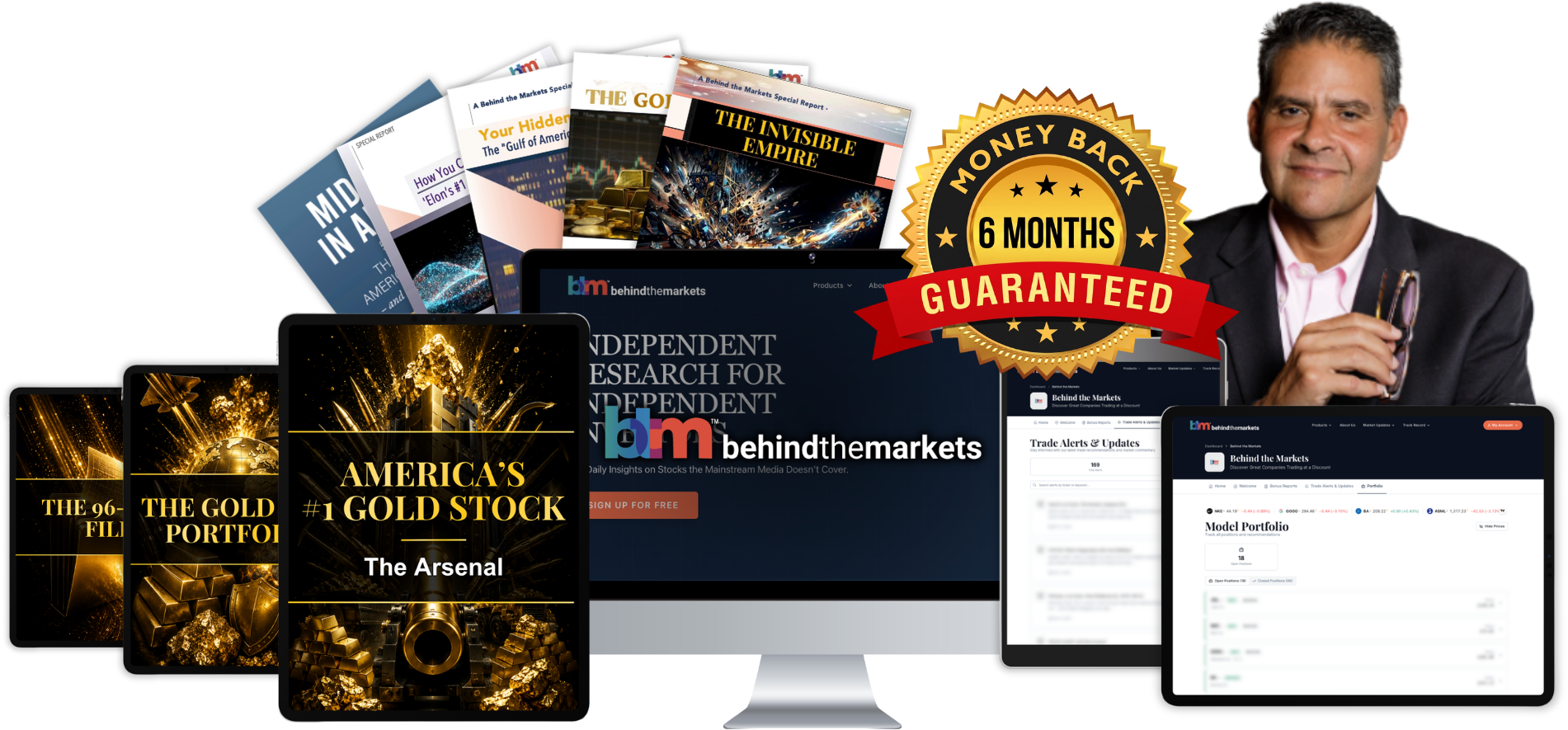
The price is $49 for a full year, originally $399. That works out to roughly 13 cents a day. Jovine anchors this against a Bloomberg Terminal ($31,980/year), an elite financial advisor (~$10,000/year plus 20% of gains), and a monetary-policy consultant ($1,000+/hour).
The guarantee is 6 months: “Take Behind the Markets for a full six months. Read every issue. Download every report. Follow every position. If at any point, for any reason, you don’t believe this is the most valuable, actionable research you’ve ever received, email our team and I’ll refund every penny.” You keep all downloaded reports even if you cancel.

Our Take
This is one of the most compelling gold-focused promotions we’ve reviewed. Here is what stands out as genuinely strong:
The research quality is exceptional. Jovine cites specific executive orders, Fed research papers, Senate bills, EXIM Bank board votes, and federal filings. The “Department of War” language in a gold mine’s filings is, if accurate, extraordinary. We have not seen another promo that goes to this level of documentary detail.
The track record is real and verifiable. The housing crash call of 2006 is documented. The Palantir recommendation at $7 is verifiable. The 71% win rate across all closed positions is a credible, honest statistic that includes losers. Jovine does not pretend every call is a winner.
The Paulson connection adds significant credibility. John Paulson is one of the most respected macro investors alive. His $185 million position in a single tiny gold stock, with his partner installed as chairman, is a strong signal that sophisticated investors take this company seriously.
The free Kinross pick shows confidence. Giving away a real, tradable stock pick before asking for money demonstrates that Jovine’s research has standalone value.
What to consider: The 10,000% gain projection is based on a historical outlier (Copper Lake in the 1970s). Most gold stocks in the rewrites returned far less. The Arsenal company produces no revenue yet, so this is an early-stage investment with real risk. The “third rewrite” thesis is an interpretation of government actions, not a confirmed policy. And the $49 price, while excellent value, is a recurring subscription, so understand what you’re committing to after the guarantee period.
We recommend this for investors who want exposure to the gold thesis and appreciate deeply researched, geopolitically informed analysis. The $49 price point with a 6-month guarantee makes this one of the lowest-risk ways to evaluate a high-quality research service.
Where to Learn More
- For a complementary perspective on the coming AI infrastructure boom, see our Accelerated AI review for how photonics could transform data center speeds.
- If you’re concerned about the AI bubble side of the macro picture, see our AI Black Paper review covering Jim Rickards’ market crash thesis.
- For more gold-focused analysis, see our Stansberry End of Dollar Reboot review.
- See our Behind the Markets publisher profile for more on the publisher behind this promo.
- Have a promo you want us to vet? Submit it here.
- Ready to try Behind the Markets? Click here to learn more.
NewsletterVetter is an independent publication. We receive compensation from some of the services we review through affiliate links. Nothing on this site is investment advice. Always do your own research.