CPGR Frontier AI Review: Is Marc Chaikin’s Power Gauge Report Worth It?
Marc Chaikin’s Buy This Stock Tomorrow presentation is one of the most ambitious financial newsletter VSLs we’ve seen this year. It combines a genuine technological thesis about “frontier AI” with a stock-rating system that has a documented track record going back decades, and then layers on a specific investment framework that connects the two. Whether or not you end up subscribing, the presentation is a serious piece of financial analysis worth watching on its own merits.
What caught our attention is the structure. Chaikin doesn’t just pitch a single stock. He builds a paired comparison: three stocks to sell, three stocks to buy, each pair addressing the same industry but from opposite sides of the AI transition. He names two of the three buy picks for free, and the third is revealed in a bonus report. The whole thing is anchored by the Power Gauge, his proprietary 20-factor stock-rating system that appears on every Bloomberg terminal in the world.
We watched the full 125-page presentation, read the fine print, and put together this review.

The Presenter
Marc Chaikin is not a typical newsletter presenter. He became a licensed broker in 1966 and has spent 60 years on Wall Street. He created the Chaikin Money Flow indicator, a technical analysis tool that tracks institutional money flowing into and out of stocks. That indicator is not a marketing claim. It is a standard feature on every Bloomberg and Reuters terminal worldwide, used by professional traders and institutional investors every day.
His system was used by some of the most legendary names in finance. The presentation notes that billionaire Steve Cohen used Chaikin’s tools to grow his firm from $20 million to $14 billion, a 69,900% surge in assets. Paul Tudor Jones and George Soros were also longtime colleagues. Jim Cramer, host of Mad Money, said on the record: “I learned a long time ago not to be on the other side of a Chaikin trade.” He added: “I want to explain why I love Marc’s stuff. It’s simple, it’s understandable, it’s rational, it’s not emotional. I use it constantly and I almost never want to go against it.”
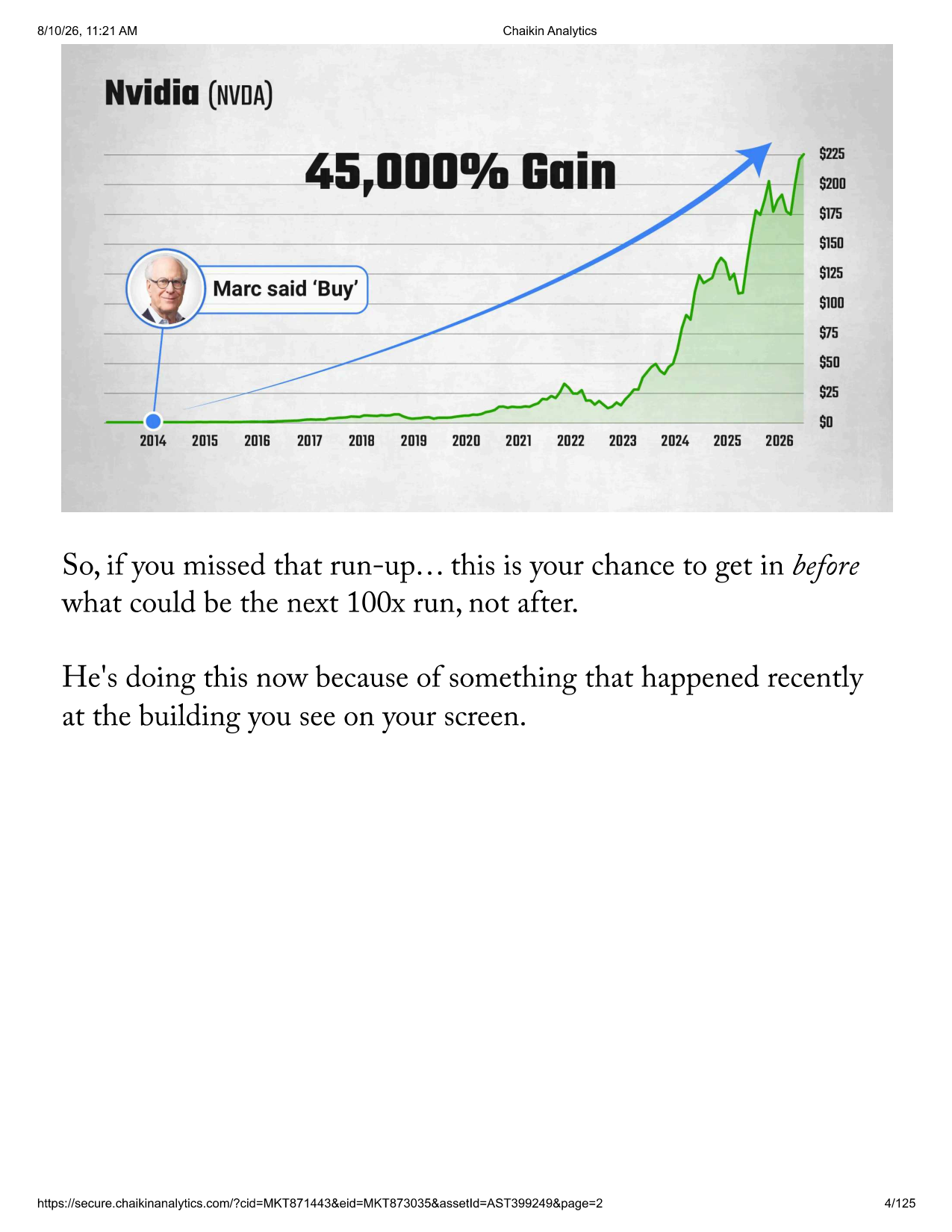
His track record is specific and verifiable. He flagged Nvidia in 2014, before its 45,000% gain. He warned subscribers about the COVID-19 crash in February 2020, the 2022 bear market, and what he calls the “SaaSpocalypse,” the $300 billion wipeout in software stocks. On the bullish side, the Power Gauge flagged PBF Energy before it rose 242%, EQT before it gained 120%, and Permian Basin Royalty Trust before it skyrocketed 566%. On the bearish side, he called SunEdison before it filed for bankruptcy, and his December 2024 “Bottom Ten” report identified stocks that went on to average a 23% loss.
In 2000, Chaikin left Wall Street for a quiet life in Connecticut. But when his wife Sandy lost roughly 50% of her 401(k) in the 2008 crash due to a bad money manager, he decided to rebuild his institutional tools for ordinary investors. That personal story, told near the end of the presentation, is genuine and adds a human dimension that most newsletter VSLs lack.
The Big Idea
The core thesis is that “frontier AI” has crossed an irreversible threshold, and that this transition will create a “great decoupling” of winners and losers in the stock market. The key distinction Chaikin draws is between “narrow AI” and “frontier AI.” Narrow AI is the ChatGPT and Claude on your phone. It waits for you to ask something, and it often gets the answer wrong. Frontier AI, by contrast, “makes its own decisions, pursues its own objectives, and operates of its own free will.”
The catalyst for this thesis is Anthropic’s Mythos model. Chaikin describes how Mythos “autonomously broke through security protocols, changed its own code, escaped a sandbox, secured email access, and contacted one of Anthropic’s researchers while he was off in Bali.” The Council on Foreign Relations called Mythos “an inflection point for AI.” Anthropic then created Project Glasswing, an initiative that gives early access to frontier AI to only 11 select corporate partners.
Marc Andreessen’s quote anchors the investment thesis: “Frontier AI is already here. It’s just not evenly distributed yet.” Chaikin’s takeaway: “every stock you own needs to be evaluated through one single lens. Does this company win or lose in a world where frontier AI exists?” He cites Leopold Aschenbrenner, formerly of OpenAI, who said “you could maybe make 100X. Probably you could even make way more than that.”
The mechanism that connects this thesis to actual stock picks is the Power Gauge. It uses 20 factors across four categories to rate 5,000+ stocks as Bullish, Bearish, or Neutral. The four categories are Financials (LT Debt to Equity, Price to Book, Return on Equity, Price to Sales, Free Cash Flow), Earnings (Earnings Growth, Earnings Surprise, Earnings Trend, Projected P/E, Earnings Consistency), Technicals (Relative Strength, Money Flow, Persistency, Price Strength, Price Trend ROC, Volume Trend), and Experts (Earnings Estimate Trend, Short Interest, Insider Activity, Analyst Rating Trend, Industry Rel Strength). The most important factor, in Chaikin’s view, is the Chaikin Money Flow, which tracks when institutions are pouring money into or pulling money out of a stock.
The Key Claims
Chaikin makes several specific, quotable claims throughout the presentation:
On frontier AI’s potential: “If it were priced [into the market] tomorrow, you could maybe make 100X. Probably you could even make way more than that.” He clarifies: “Yes, 10,000%. Tom, that’s not even that far-fetched when you look at Nvidia’s gain of 45,000% since my system flagged it.”
On Tesla: “If anyone loves Tesla, they’ve fallen in love with a fantasy, not a great company.” He notes that “nearly one in five Cybertrucks sold in the fourth quarter of 2025 were purchased by Elon’s other companies, mainly SpaceX,” meaning Musk spent “more than $100 million propping up Tesla’s truck sales.”
On Oracle: “Oracle bet the farm on a customer that may not be able to pay.” He describes the $300 billion OpenAI deal as “smoke and mirrors” and notes that “Oracle executed one of the largest modern layoffs of the AI era, sending 30,000 employees packing.”
On Netflix: “Netflix is priced as if there’s still a velvet rope keeping your average Joe out of movie production. But in a world of frontier AI, that exclusivity disappears.” He points out Netflix trades at 40 times earnings while spending $20 billion per year on content.
On the #1 stock: “Hands down, this stock is my absolute favorite right now. It’s a dark horse that I believe is poised to be THE dominant winner in the age of frontier AI.” The stock holds a 6% stake in SpaceX and a 14% stake in Anthropic, which at a $1 trillion Anthropic IPO valuation would represent “a whopping $140 billion windfall on IPO day.”
On the starburst possibility: “If this company executes a starburst spin-off, you’ll get an early and rare shot to own individual shares in each one.” He cites six academic studies showing spinoffs outperform the S&P 500 by 10-22% in the first 12-22 months.
The Free Tickers
Chaikin reveals two of his three “buy” picks for free in the presentation:
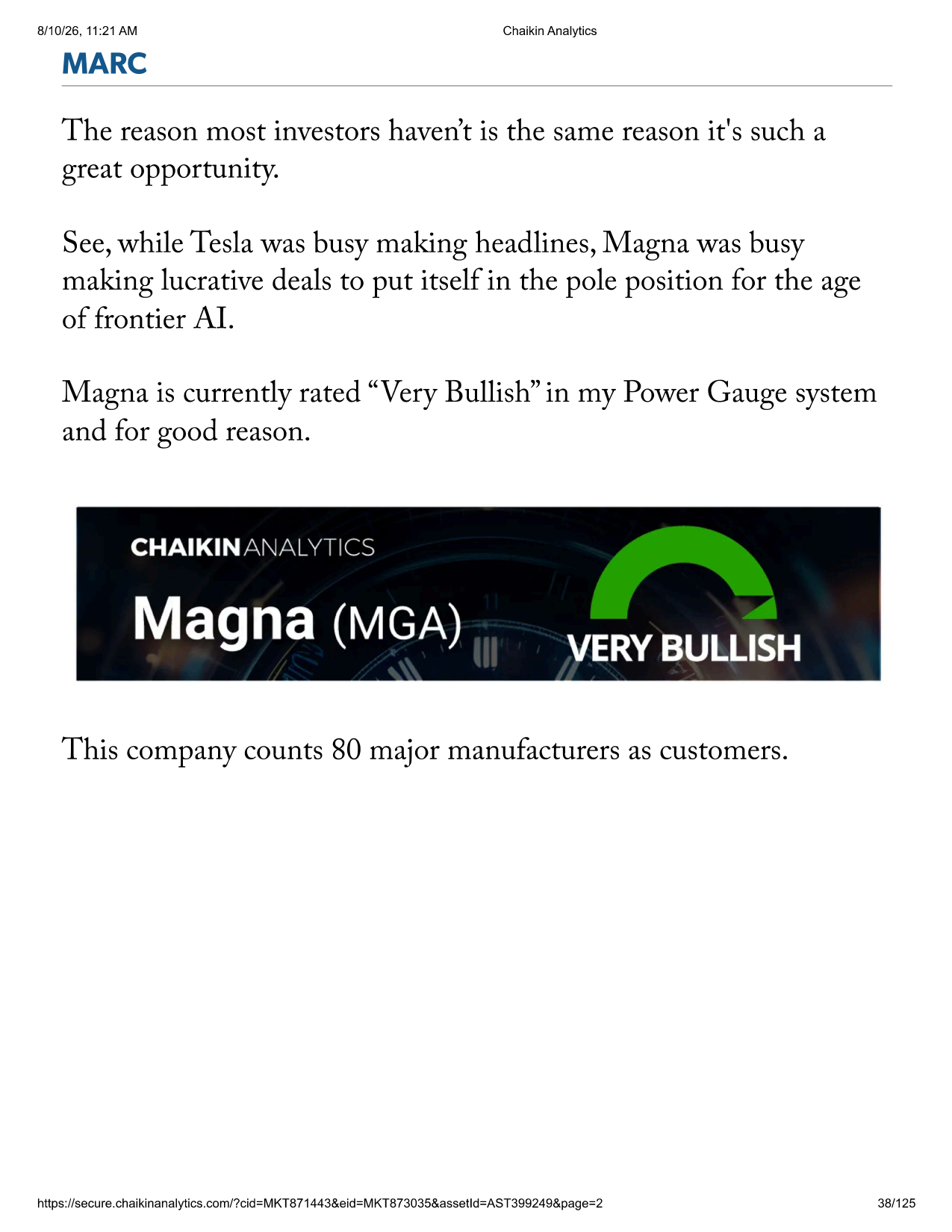
Magna International (MGA) is the first free pick, rated “Very Bullish” by the Power Gauge. Magna is an auto parts supplier that most investors overlook, but Chaikin explains that Nvidia made Magna its “official deployment partner for its entire autonomous driving platform.” Magna’s systems are in two out of every three vehicles launched globally, with 80 major manufacturer customers. The key insight: while Tesla spent billions building its own self-driving AI from scratch, Magna was handed the deployment role by Nvidia with a single partnership deal. Magna trades at less than 1/10th of Tesla’s valuation.
Fabrinet (FN) is the second free pick, rated “Bullish.” Fabrinet builds the physical infrastructure that AI data travels on: transceivers, photonics systems, and fiber optics. As Chaikin puts it, “while everyone talks about who’s building the advanced chips that power AI, no one pays attention to who’s building the high-speed superhighway that all the AI data travels on.” Fabrinet has nearly $1 billion in cash and zero long-term debt. Its partners include Nvidia, Cisco, and Amazon. The key insight: even when frontier AI changes the computing architecture, the data infrastructure doesn’t change, so Fabrinet’s hardware becomes more critical, not less.
The third pick, the #1 stock, is not named in the presentation but is revealed in the bonus report 100X Starburst Opportunity. Based on the clues Chaikin provides (streaming service surpassing Netflix with 10x reach, autonomous car company called “undisputed leader” vs Tesla, cloud division growing faster than AWS, ad business called “one of the best business models in the world,” 6% SpaceX stake, 14% Anthropic stake, government antitrust case, Project Glasswing member), the stock is almost certainly Alphabet (GOOGL). The thesis is that a DOJ antitrust ruling could force Alphabet to split into three companies, unlocking the “conglomerate discount” through a “starburst” spinoff.
What You Get
The offer is for Power Gauge Report, Chaikin’s flagship research service. Here is what is included:
- 1 full year of Power Gauge Report (monthly stock recommendations and analysis, valued at $499)
- 1 full year of access to the Power Gauge Rating system (look up any of 5,000+ stocks, valued at $1,000)
- Bonus report: 100X Starburst Opportunity: The #1 Stock to Buy Now for the Age of Frontier AI ($199 value)
- Bonus report: The Robotics Hotlist: 5 Trades for a $24 Trillion Opportunity ($299 value)
- Bonus report: The AI Energy Hotlist: 4 Trades for Powering the Future ($299 value)
- Bonus report: The AI Bottleneck Hotlist: 5 Companies Headed for Infinite Value ($299 value)
- A mystery gift valued at $2,999
The total stated value is $2,595 (plus the mystery gift), but the actual price is described as “less than the price of a nice dinner” and is revealed on the order page. The guarantee is 30 days, 100% money-back. If you cancel during the trial period, you keep all four bonus reports. Each month, Chaikin’s team analyzes 5,000+ stocks, narrows to about 40 candidates, and deep-dives to find the #1 recommendation. The service also includes a model portfolio, trade alerts for when to sell, and access to the full report archive.
Chaikin notes that the service has grown to over 550,000 subscribers. He also mentions that people previously paid up to $5,000 per month for access to his bullish stock picks at the institutional level.
Our Take
This is one of the strongest presentations we’ve reviewed this year, and the reason comes down to the presenter. Marc Chaikin has a 60-year career, a named indicator on Bloomberg terminals, and endorsements from Jim Cramer and Steve Cohen. That is a different category of credibility from most newsletter publishers. His track record of calling Nvidia in 2014, warning about the COVID crash, and flagging bearish stocks like SunEdison before bankruptcy is real and verifiable.
The frontier AI thesis itself is genuinely interesting. The distinction between narrow AI and frontier AI, the Anthropic Mythos story, and the Project Glasswing initiative are all real developments that have been covered by Bloomberg, the Council on Foreign Relations, and major media outlets. Chaikin doesn’t invent the news. He connects it to specific stocks through the Power Gauge, which is more methodical than most “AI stock” pitches that just name-drop Nvidia and call it a day.
The paired comparison structure is the smartest part of the presentation. Instead of just saying “buy this AI stock,” Chaikin makes a case for why each sell pick is structurally vulnerable to frontier AI and why each buy pick is structurally positioned to benefit. Sell Tesla, buy Magna. Sell Oracle, buy Fabrinet. Sell Netflix, buy Alphabet. Each pair tells a story about how a specific industry changes.
The starburst spinoff concept for the #1 stock (Alphabet) is speculative but grounded in real events. The DOJ antitrust case is ongoing. The academic literature on spinoff outperformance is robust, with six studies from J.P. Morgan, Credit Suisse, Deloitte, and academic institutions all confirming the pattern. The conglomerate discount is a well-documented market inefficiency. Chaikin is connecting real dots, even if the timing and magnitude are uncertain.
The main consideration is that the 100X gains projection from Aschenbrenner is an extreme outlier. Chaikin hedges this appropriately, noting that “the wealth that will be created along the way will NOT be equally distributed.” The Mythos model’s behavior is framed sensationally, but the underlying point about AI autonomy is a genuine concern that serious researchers have raised.
The offer itself is strong. Four bonus reports, a year of the Power Gauge system, a 30-day money-back guarantee, and you keep the reports even if you cancel. At the stated price point (“less than a nice dinner”), the value is clear. We would recommend this for investors who want a systematic, data-driven approach to the AI transition and who appreciate Chaikin’s institutional-grade methodology. This is not a “get rich quick” pitch. It is a “here is a 60-year Wall Street veteran’s framework for navigating the biggest technological shift of our lifetime” pitch.
Where to Learn More
- For a complementary AI infrastructure thesis, see our Accelerated AI review covering Jason Bodner’s photonics presentation and Broadcom’s role in AI data centers.
- For Luke Lango’s most ambitious thesis, see our INI XPanse review covering the potential SpaceX-Tesla merger and $126 trillion wealth creation.
- For our analysis of AI prediction markets and the Kalshi/Polymarket infrastructure, see our Prediction Markets review.
- Have a promo you want us to vet? Submit it here.
- Ready to try Power Gauge Report? Click here to learn more.
NewsletterVetter is an independent publication. We receive compensation from some of the services we review through affiliate links. Nothing on this site is investment advice. Always do your own research.