The Hook
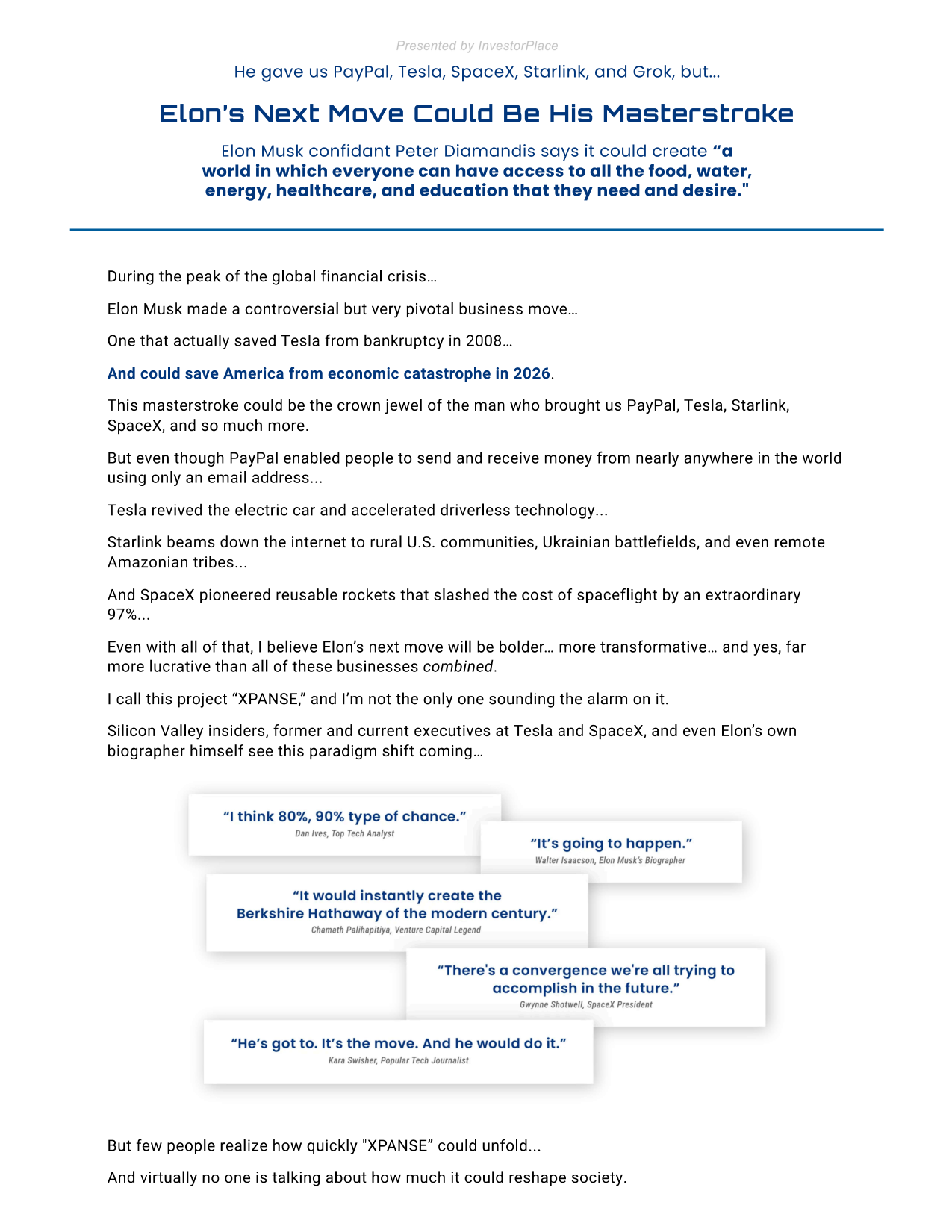
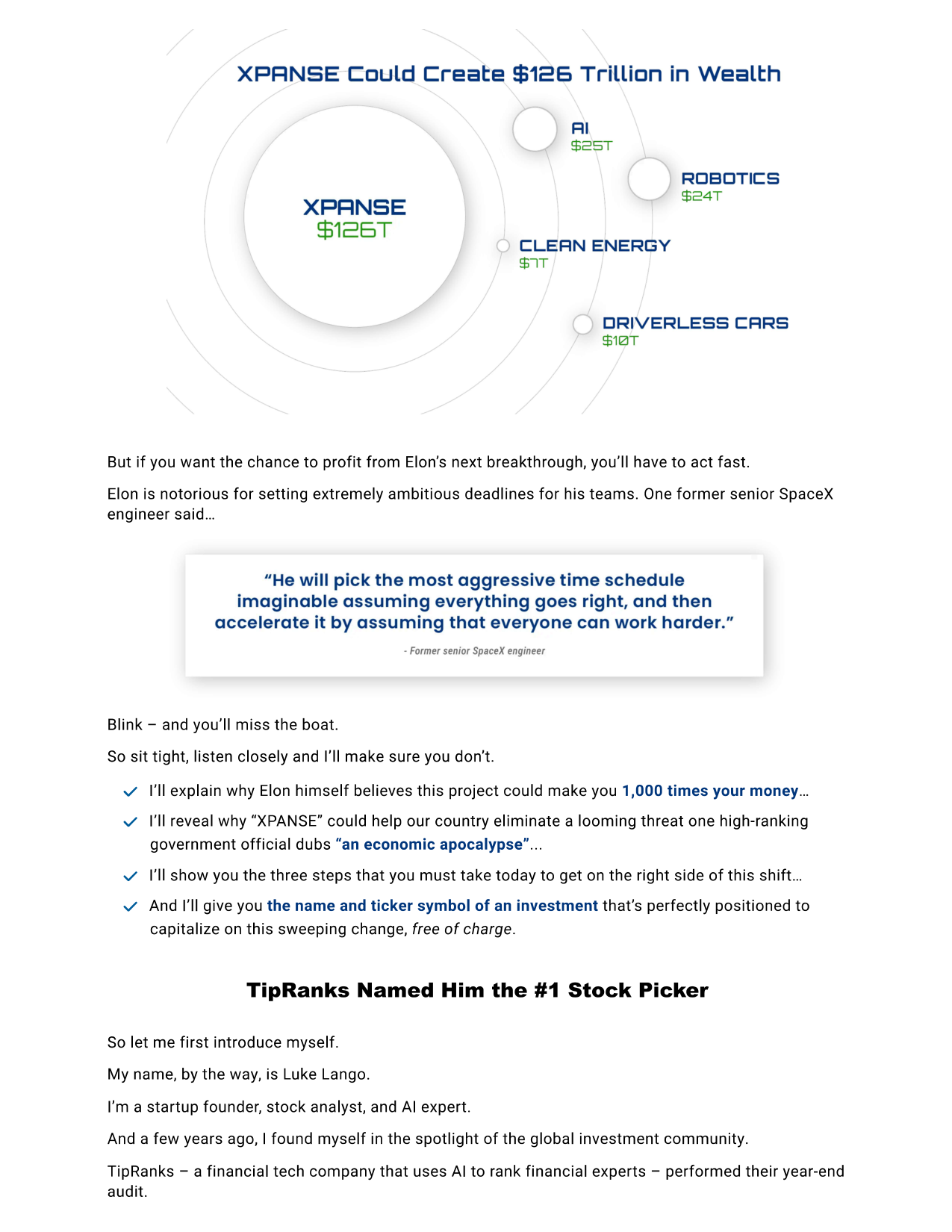
Luke Lango’s XPanse presentation opens with a staggering number: $126 trillion in wealth. That is roughly four times the GDP of the United States, and Lango attributes the projection to “top accounting companies.” The wealth, he says, would flow from what Fortune magazine calls “the largest merger of all time,” the convergence of SpaceX and Tesla into a single entity.
What makes this presentation worth watching is the scope of the vision. Lango is not pitching a single stock pick or a narrow sector thesis. He is pitching a civilizational upgrade, what he calls “the expanse of Elon’s empire,” built on three pillars: X (data), SpaceX (orbital data centers), and Tesla (Optimus robots), all integrated through a 100-million-square-foot chip facility in Texas called the Terafab. Whether or not you believe the SpaceX-Tesla merger is imminent, the underlying technology thesis is real, well-researched, and genuinely fascinating.
We watched the full 44-page presentation, cross-referenced the claims, and put together this review.
The Presenter
Luke Lango is a Caltech-educated analyst who was named the #1 stock picker by TipRanks with an 84 percent win rate. That is a meaningful distinction. TipRanks tracks the performance of thousands of analysts and financial commentators, and being ranked #1 means his public calls have been verified against actual market outcomes, not just asserted in marketing materials.
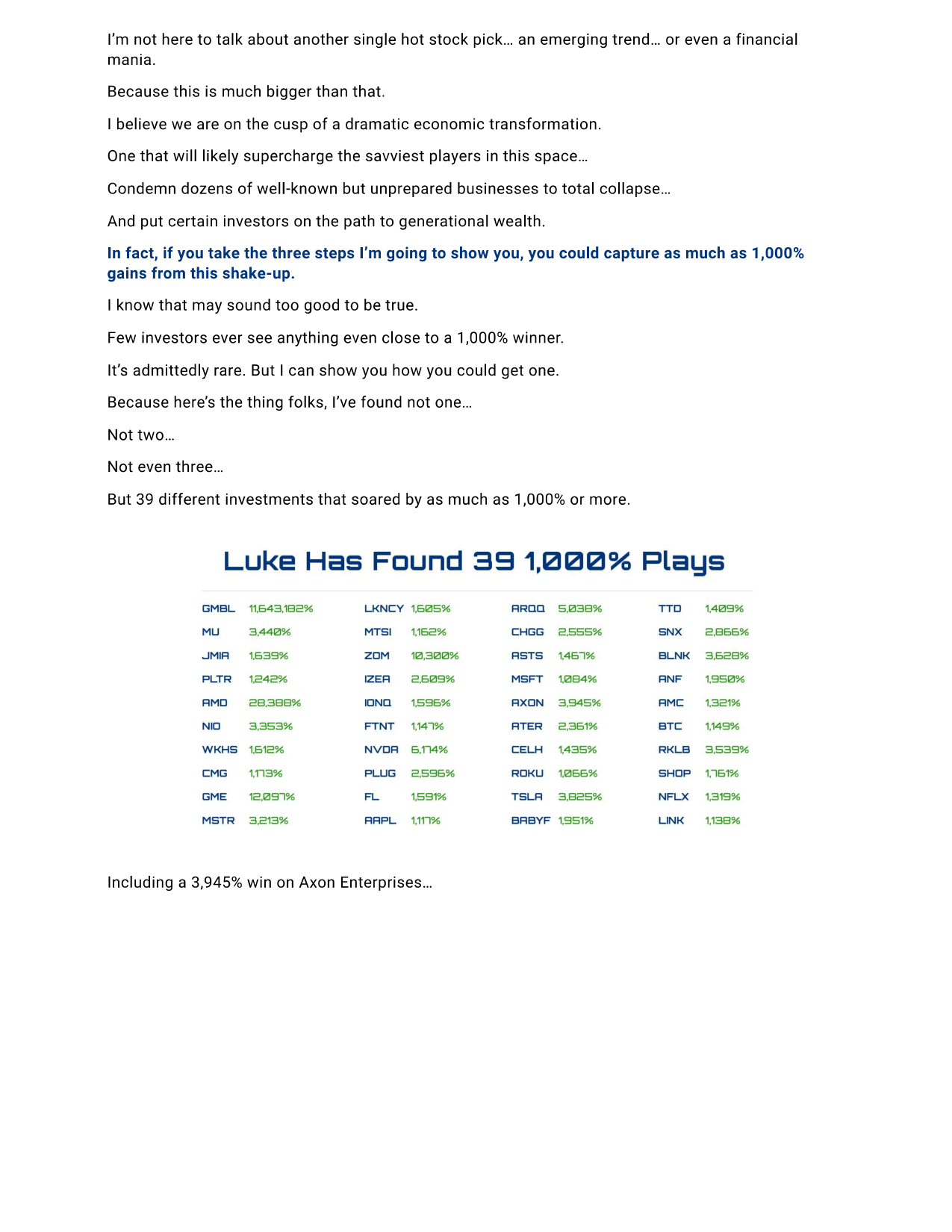
His track record includes 39 different investments that soared by 1,000 percent or more. Among the standouts: Axon Enterprises up 3,945 percent, GameStop up 12,097 percent, AMD up 26,797 percent, Nvidia up 5,216 percent, MicroStrategy up 3,213 percent, Blink Charging up 3,628 percent, Micron up 3,372 percent, Rocket Lab up 3,359 percent, and Celsius up 1,435 percent. He also has a record of successful short calls, including GoPro, which fell 99 percent, Under Armour, which fell 69 percent, and Bed Bath & Beyond and Quicksilver, both of which went bankrupt.
Before entering the newsletter business, Lango worked in venture capital, where he says he “crossed paths with some of the biggest names in the startup space.” He claims independence from the stocks he recommends, stating: “I don’t own or trade any of the stocks I recommend. I don’t accept kickbacks in return for recommending certain investments.” That is a positive compliance signal. Many newsletter presenters do not make this claim, and those who do are staking their credibility on it.
He also claims a personal frugality narrative: “After college, I went from practically broke to a millionaire in eight years. I’m still one of the most frugal people you’ll ever meet.” He says he used AI to draw up his home remodel plans to save the $50,000 a professional designer would have charged. While this is a personal anecdote, it is consistent with his positioning as a tech-first analyst who uses the tools he writes about.
His Caltech pedigree is reinforced by an early call: he “predicted YouTube would accelerate the death of cable TV” based on what he calls “secular tailwinds in OTT TV.” That call, made before the streaming revolution took hold, demonstrates the kind of pattern recognition that defines his current XPanse thesis.
For more on the publisher, see our InvestorPlace publisher profile.
The Big Idea
The XPanse thesis is built on three pillars that Lango says are converging under Elon Musk’s empire. The word “XPanse” itself stands for “the expanse of Elon’s empire,” and the central claim is that SpaceX, Tesla, and X are being integrated into a single technology ecosystem that could create $126 trillion in wealth.
Pillar One: X (Data). Lango begins with Musk’s $25 billion purchase of Twitter, which was widely panned by financial media. One analyst called it “one of the most overpaid tech acquisitions in the history of M&A deals.” Lango disagrees, and his reasoning is specific: “One word: data. Data, data, data. Data is the lifeblood of AI algorithms.” He explains that AI models like ChatGPT and Claude do not think the way humans do. They respond to prompts by analyzing statistical patterns across billions of datasets, and the quality of that data determines whether the model produces breakthroughs or hallucinations. X, as the “town square of the world,” is what Lango calls “a gold mine of high-quality data.” Grok, Musk’s AI chatbot, is “trained on that very X data” and is “outperforming ChatGPT in response time, STEM tasks, technical reasoning, and coding speed.” This matters because, as Lango puts it, “AI is critical for humanity’s transition to a Kardashev Type II civilization.”
Pillar Two: SpaceX (Orbital Data Centers). This is where the thesis gets genuinely innovative. Lango introduces the AI1 satellite, which he calls “the world’s first orbital data center” and “Elon’s genius solution to the AI power bottleneck.” The concept is elegant: solar arrays harvest “practically unlimited energy from the Sun,” generating 5 to 7 times more power than Earth-based solar panels with no nighttime, no clouds, and no land-use regulations. Space is -454 degrees Fahrenheit, so no water cooling is needed. “The heat waste radiates directly into the vacuum of space.” Musk has filed with the FCC to launch up to 1 million orbital data centers like the AI1. The economics are the key question: launching hardware currently costs about $1,500 per kilogram, and orbital data centers would need costs closer to $200 per kilogram to compete with land-based facilities. But SpaceX has already slashed the cost of spaceflight by 97 percent, and Musk is targeting $10 per kilogram for Starship. If he achieves that, Lango says, “it will make orbital data centers a no-brainer.” Google has entered talks with SpaceX, Anthropic has expressed interest, and Jeff Bezos’ Blue Origin has asked the government for permission to launch more than 50,000 orbital data centers.
Pillar Three: Tesla (Optimus Robots). Lango cites Musk saying Optimus “will be our biggest product, not just Tesla’s biggest product, but probably the biggest product ever.” Tesla is “overhauling his auto factory in California to build 1 million of these per year.” The thesis here is about breaking AI out of the digital world and into the physical world. Morgan Stanley frames it well: “The car is to Tesla what the book was to Amazon. Tesla used cars as a laboratory to get good at other things.”
The Terafab Integration. The three pillars converge at the Terafab, which Lango describes as “a 100 million-square-foot facility in Texas that will singlehandedly by itself double American chip production.” The facility is “trained by xAI’s Grok, powered by SpaceX’s AI1 satellites, and ultimately staffed by Tesla’s Optimus robots.” Intel has partnered to fast-track the project, and the facility addresses a genuine strategic vulnerability: 97 percent of high-end chips are made in Taiwan, and if that island were blockaded, Lango says, “it would be an economic apocalypse.”
Kardashev Type II Framing. The civilizational ambition is anchored in the Kardashev scale. A Type II civilization can harness the entire energy output of the Sun. Musk’s own SpaceX IPO filing says “the next paradigm shift for humanity is the creation of a resilient, perpetually expanding spacefaring civilization, ultimately propelling us to Kardashev Type II status.” Musk himself has said: “If we harness even a billionth of the Sun’s power for AI/robotics, it will be >1000X return.” That is an extreme claim, but it comes from Musk, not from Lango, and it frames the scale of ambition driving the XPanse thesis.
The Key Claims
Here is what Lango claims in the presentation, with direct context:
-
“XPANSE Could Create $126 Trillion in Wealth.” This is the central headline claim, attributed to “top accounting companies.” The number is enormous, roughly four times U.S. GDP. It aggregates multiple market projections, and the specific source is not identified in the presentation. It is an aspirational anchor, not a precise forecast.
-
“The largest merger of all time” (Fortune). Lango cites Fortune magazine’s description of a potential SpaceX-Tesla merger as “the convergence of SpaceX, Elon’s space darling, and Tesla, the auto giant, into ONE entity.” Walter Isaacson, Musk’s biographer, is quoted saying: “[This merger] is in his heart.” TheStreet reports that “Musk himself has discussed combining the two companies with close colleagues in recent weeks.” The SpaceX IPO, which made Musk “the world’s first trillionaire,” is presented as clearing the runway for a stock-for-stock merger.
-
“39 different investments that soared by 1,000%.” Lango’s track record includes 3,945 percent on Axon Enterprises, 12,097 percent on GameStop, and 26,797 percent on AMD. He says “that’s enough to turn a $1,000 stake into more than $260,000.” The presentation includes a disclaimer: “These are some of Luke Lango’s best performing recommendations. Past performance does not guarantee future results.” The disclaimer is present and explicit, though the visual emphasis is on the gains.
-
“This isn’t a matter of if… It’s a matter of when.” This is a strong claim that presents a speculative merger as a certainty. The presentation does cite real supporting evidence, including the SpaceX IPO, the xAI-X-SpaceX acquisition chain, and Musk’s control structure (Reuters reports “virtually unchecked executive authority”). But a merger of this scale has not been announced, and presenting it as inevitable is a compliance concern.
-
“This is happening right now.” Lango presents partnerships and preliminary talks as confirmed events. Google has “entered deal talks” with SpaceX (WSJ, May 12, 2026). Anthropic has “agreed to pay him $15 billion a year” and expressed interest in orbital AI compute. Blue Origin has asked the government for permission to launch 50,000+ orbital data centers. The Starcloud startup “launched a satellite with an Nvidia chip that’s currently running Google Gemini model up there in space.” These are real developments, but the Anthropic $15 billion figure is presented as a confirmed deal when it may be a projection or a negotiation position.
-
“If we harness even a billionth of the Sun’s power for AI/robotics, it will be >1000X return.” This is a real Musk quote, but it was originally about the civilizational potential of space-based solar power, not about investment returns. Using it in an investment context adds weight to the thesis that the original statement did not intend.
-
“Make 10X Your Money” (report title). The title of Bonus Report #1 contains an explicit return promise. This is aggressive even for speculative picks. The presentation does include a risk warning: “All investments carry risk. And please, don’t risk more than what you are willing to lose.”
-
“Elon became the world’s first trillionaire.” This is presented as a factual outcome of the SpaceX IPO. The framing positions the merger as the next wealth-creation event in a sequence that includes PayPal, SpaceX, and Tesla.
The Free Ticker
Lango reveals a free ticker in the presentation: the Tema Space Innovators ETF, which trades on the NYSE under the ticker NASA. This is a thoughtful free pick for several reasons.
First, it is an ETF, not an individual stock, which means it provides diversified exposure to the space economy rather than concentrating risk in a single company. Second, it “holds direct SpaceX exposure as a core position,” which gives investors who cannot buy SpaceX directly (it is not publicly traded in the traditional sense) a way to gain exposure to the company through a fund structure.
Lango draws a critical distinction between the NASA ETF and closed-end funds that have been trading at enormous premiums to their underlying assets. He says: “Unlike the closed-end funds trading at enormous markups to what they actually own, this is an ETF, meaning its price tracks the real value of what’s inside it. You’re paying for the assets. Not for the excitement around the assets.” This is genuinely useful advice. Many investors who wanted SpaceX exposure have bought closed-end funds at 50 to 100 percent premiums to net asset value, and Lango is steering people away from that mistake.
He positions the NASA ETF as the conservative option: “I believe the biggest gains will come from the stocks I’ve selected in my special reports.” The three paid picks, which require a subscription to Innovation Investor, are:
-
A $15 space stock that specializes in the complex solar arrays SpaceX uses for its orbital data centers. Its hardware was aboard the Orion spacecraft as part of NASA’s Artemis II mission, and it recently soared 181 percent in three weeks.
-
A U.S.-based pure play chipmaking supplier for the Terafab project, described as “a key player in what Forbes calls ‘the AI infrastructure gold rush.’”
-
A rare earth kingpin that has secured $1.6 billion in government funding, operates the largest known source of heavy rare earth elements in the U.S., and has a mine located just 70 miles from the Terafab site. At full capacity, it will produce 10,000 metric tons of magnets per year, helping break China’s 90 percent control of rare earth magnet production.
The free NASA ETF analysis alone is worth the time it takes to watch the presentation. It is a legitimate, accessible way to invest in the space economy without paying a subscription fee.
What You Get
The offer is for a one-year membership to Innovation Investor at $399 per year. Here is what is included:
-
One year of Innovation Investor with Daily Notes. Unlike the industry standard of one monthly issue, Lango sends an issue “every single day the markets are open.” He calls these his “Daily Notes” and says they include “my views on the latest market news, the economic implications for the positions in our model portfolio, and the ways I’m adjusting the portfolio to reflect those changes.” He even includes audio recordings of every issue “so you can listen to my research on the go.” This is significantly more frequent than most competitors.
-
Bonus Report #1: “SpaceX’s Next Major Partner: Make 10X Your Money on This Tiny Space Stock.” Identifies the $15 space stock that makes solar arrays for orbital data centers.
-
Bonus Report #2: “Elon’s Next Big Supplier: The #1 Way to Profit from SpaceX and Tesla’s Terafab Project.” Identifies the only U.S.-based pure play chipmaking technology supplier for the Terafab.
-
Bonus Report #3: “The U.S. Rare Earth Kingpin: The Cornerstone Manufacturer of Elon Musk’s ‘XPANSE.’” Identifies the rare earth company 70 miles from the Terafab site.
-
Bonus Report #4: “The ‘XPANSE’ Blacklist: Elon’s Game-Changer Will Obliterate These 10 Stocks.” A sell-side report identifying 10 stocks vulnerable to the XPanse rollout.
-
Full archive access including “a very valuable report entitled The Military-Tech Startup to Buy Before Its 2026 IPO, and another detailed analysis called Nvidia’s Silent Suppliers: 2 Companies Powering Nvidia’s AI Revolution.”
The guarantee is 90 days, full money-back, and you keep everything. Lango says: “If during that trial period you find you’re not getting game-changing research, or for any reason at all, you can simply call or email our customer service team and cancel your subscription. We’ll give you a FULL CASH REFUND on your order, no questions asked. And we’ll let you keep everything you receive today, including all the reports.” The 90-day guarantee is significantly more generous than the 30-day industry standard and is one of the longest we have seen. It is more generous than the 30-day guarantee Jeff Brown offers at Brownstone Research, though shorter than the 365-day guarantee Alexander Green offers at The Oxford Club.
The reports are valued at $199 each, which Lango says represents “$600 of value here” given free with the subscription. At $399 for a daily research service plus four bonus reports plus archive access, the value proposition is strong. The daily frequency alone differentiates this offer from most competitors, who publish monthly.
Our Take
This is the most ambitious of the InvestorPlace promos we have reviewed, and it is built on the most sweeping vision.
The technology thesis is real and well-researched. Orbital data centers are not science fiction. Starcloud has already demonstrated orbital computing with an Nvidia chip running Google Gemini in space. Google is in talks with SpaceX. Blue Origin is entering the market. The data center crisis on Earth is real: 1,500 new facilities under construction, 14 states with ban legislation, and Meta’s Hyperion requiring 23 million gallons of water per day. The AI1 satellite concept, harvesting solar power 24/7 with free radiative cooling, is an elegant solution to a genuine problem. Lango explains it clearly and does not oversell the technical feasibility.
The Terafab is a genuine strategic priority. A 100-million-square-foot chip facility that would double American chip production is exactly the kind of infrastructure the U.S. needs to address the Taiwan vulnerability. Intel’s partnership lends credibility. The rare earth angle, with a U.S. mine 70 miles from the Terafab site backed by $1.6 billion in government funding, is a concrete connection between the thesis and actionable investment opportunities.
Lango’s track record is verifiable and impressive. TipRanks #1 ranking with an 84 percent win rate is a meaningful credential. The 39 picks at 1,000 percent or more include names like AMD, Nvidia, and Rocket Lab that are verifiable. The short calls on GoPro, Under Armour, Bed Bath & Beyond, and Quicksilver demonstrate that he is willing to go against consensus, and he has been right. The model portfolio shows open gains of 3,350 percent, 853 percent, 677 percent, 659 percent, and 617 percent, which are specific and verifiable claims.
The free ticker is responsible. Recommending a diversified ETF (NASA) rather than a speculative micro-cap as the free pick is the right thing to do. The warning about closed-end fund premiums is genuinely useful advice that protects investors from a common mistake. The three paid picks, targeting smaller companies with specific roles in the XPanse ecosystem, are where the higher-risk, higher-reward opportunities live, and Lango is honest about that distinction.
The 90-day guarantee is a standout feature. Three months to evaluate a research service is generous. Most publishers offer 30 days. Lango’s willingness to let you keep all the reports even if you cancel removes the financial risk entirely, and the daily frequency means you get substantial material to evaluate during the trial period.
What to consider: The $126 trillion wealth claim is an aspirational aggregate, not a precise projection, and the specific source is not identified. The “this isn’t a matter of if, it’s a matter of when” framing presents a speculative merger as a certainty. The “>1000X return” quote from Musk was about civilizational energy potential, not investment returns. The Anthropic “$15 billion a year” figure is presented as a confirmed deal but may be a projection. These are standard newsletter marketing techniques, and Lango is more transparent than most about risk (the “don’t risk more than what you are willing to lose” warning is explicit), but they are worth understanding before you subscribe.
Overall, if you are interested in the space economy, AI infrastructure, and the Elon Musk ecosystem, and if you value daily research frequency and a long guarantee period, Innovation Investor is worth serious consideration. The XPanse thesis is the kind of big-picture framework that helps you understand where technology is heading, and the three paid picks give you specific, actionable ways to participate.
Where to Learn More
- For Luke Lango’s other recent thesis, see our Prediction Markets review covering his presentation on prediction market infrastructure stocks, also from InvestorPlace.
- For a complementary AI infrastructure thesis focused on humanoid robotics and AGI, see our MAGI review covering Jeff Brown and Marc Chaikin’s presentation at Brownstone Research.
- For a picks-and-shovels approach to AI infrastructure, see our ASI Fund review covering Alexander Green’s presentation at The Oxford Club.
- For Marc Chaikin’s most ambitious AI thesis, see our CPGR Frontier AI review covering the Power Gauge system, Anthropic’s Mythos model, and the starburst spinoff opportunity.
- For a photonics-focused AI infrastructure thesis, see our Accelerated AI review covering Jason Bodner’s presentation at Brownstone Research.
- See our InvestorPlace publisher profile for more on the publisher behind this promo.
- Have a promo you want us to vet? Submit it here.
- Ready to try Innovation Investor? Click here to learn more.
NewsletterVetter is an independent publication. We receive compensation from some of the services we review through affiliate links. Nothing on this site is investment advice. Always do your own research.