Physical AI: What Is It and Why Investors Care
Physical AI is the term for artificial intelligence embodied in the physical world rather than confined to software, and it is the organizing concept of Josh Baylin’s Starphone presentation for Stansberry Research. His framing is direct: “Physical AI is going to be one of the defining wealth-building trends of the next few years.” The first AI boom made fortunes in chips and cloud software, the training of models. The physical AI wave, on this thesis, pays the companies that move intelligence out into devices, machines, and infrastructure. Here is what the concept actually means and how the investment logic works. Our Sam Altman’s Next Venture: The 500X AI Convergence explainer covers this in detail.
The definition, in practice
The clearest way to define physical AI is by its endpoints. A chatbot answering a prompt is digital AI. A robot navigating a warehouse, a car driving itself, a satellite coordinating a network, a phone whose AI runs on orbital compute, those are physical AI. The common thread is that intelligence is attached to something that acts in the world, and that attachment creates a hardware and infrastructure layer that pure software never needed.
Baylin’s Starphone thesis is a consumer expression of the trend: a device that “could become the first truly physical AI device of its kind… Thinner than an iPhone… usable worldwide without cell towers… running on one of the most powerful AI-based platforms in existence.” Musk’s Joe Rogan quote sketches the endpoint: “I don’t think there’ll be operating systems. I don’t think there’ll be apps. The phone will just display the pixels and make the sounds.” The intelligence lives elsewhere, in orbit, on the Starmind-class compute satellites like the AI1, “the wingspan of a Boeing 747,” producing “120 to 150 kilowatts of computing power” running “on sunlight alone.”
Why the infrastructure is the investable part
The reason investors should care about the distinction is valuation geography. The digital AI wave concentrated gains in a handful of chip and cloud names. Physical AI spreads the buildout across more layers: satellite constellations, spectrum, orbital data centers, robotics components, machine vision, thermal management, and the materials underneath, “roughly 60 different elements” per device, “Nickel… Terbium… Gallium… Elon doesn’t own any of that.”
Baylin’s evidence wall for the supplier pattern is the strongest part of the case: Cadence Design Systems, supplying Tesla’s software stack, “rose as high as 16,000%.” Carpenter Technology “tripled inside of a few years” on specialty alloys. Modine “climbed as much as 18-fold” on thermal management. Amkor “as much as tripled” on packaging. Skyworks and Cirrus Logic rode the iPhone to “491%” and “489%” respectively. Every wave of physical devices, from phones to cars to satellites, has paid its component suppliers first.
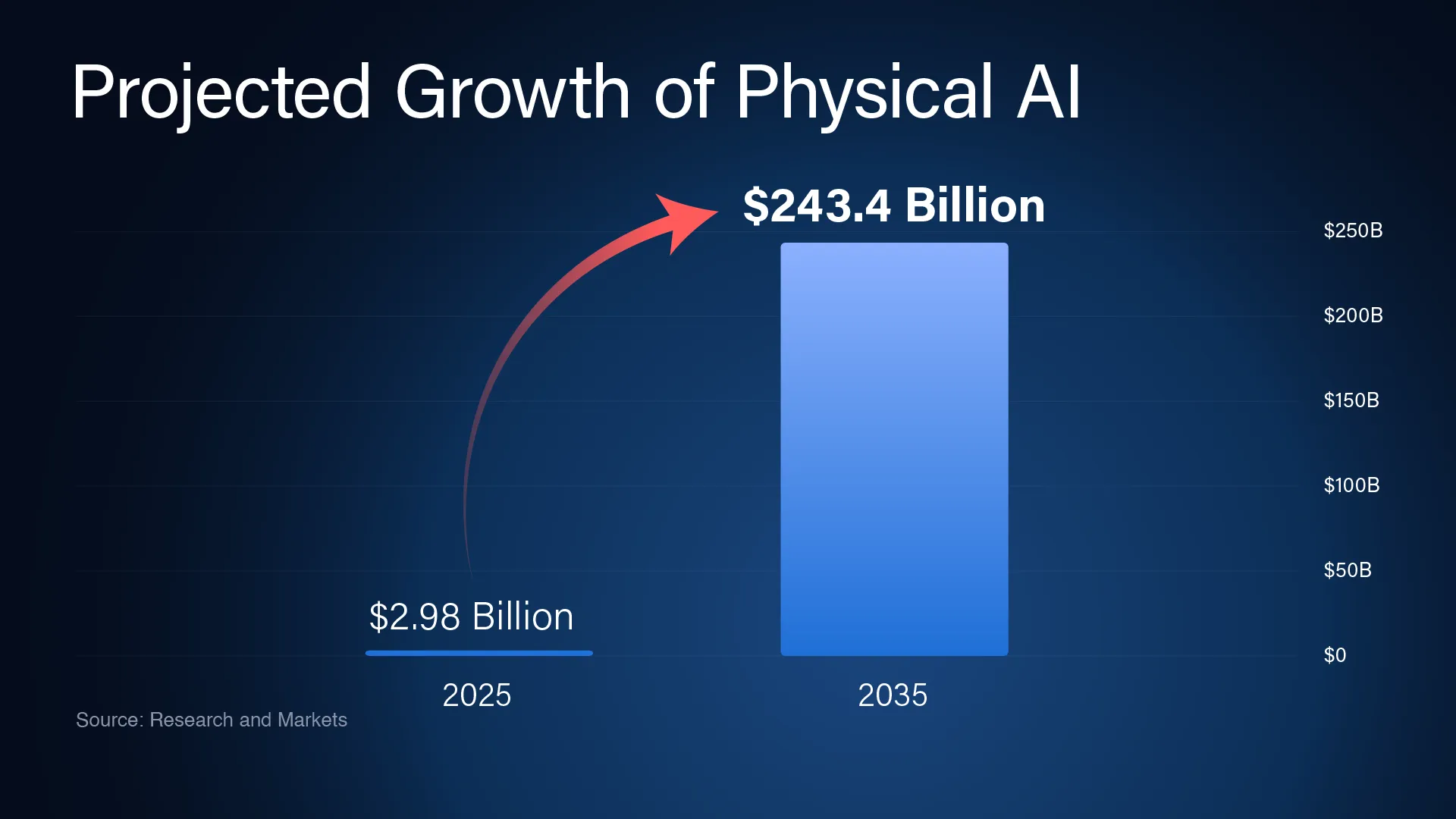
The companies in the physical AI stack
Stansberry’s companion report, “Your Financial Guide to the Physical AI Boom,” targets the layer by profile: a satellite-communications veteran (“Hikers, sailors, pilots… have all relied on this company for years”), a machine-vision company with “over twenty years allowing technology to ‘see,’” and “a company Elon’s own team just brought on to help build the chip plant behind his entire AI operation.” One of the physical AI names carries “138 hedge funds” as holders, with Steve Mandel’s firm at “a $1 billion” position, which signals the large-cap tier of the theme is already institutionally validated. We break down that angle in our A Financial Guide to the Physical AI Boom piece.
The free pick rides the same stack: Qualcomm, “already tapped… to build satellite connectivity into their future devices,” which Baylin says “could easily double over the next few years” as satellite connectivity moves into mainstream phones.
Considerations
Physical AI as a theme is real, but the specific upside cases in any presentation are opinions. The Starphone itself remains unconfirmed, with Musk having denied the phone reports twice, and Baylin’s own hedge is on the record: “Now, Elon Musk hasn’t confirmed that a Starphone is coming, of course.” The theme-level investments, satcom, machine vision, chip-plant suppliers, do not require the device to ship, which is why the cautious expression of the thesis is the infrastructure rather than the headline gadget. The blanket disclaimer applies throughout: past supplier runs are maximum historical gains, not forecasts.
Questions readers ask about physical AI
Is physical AI a real category or a newsletter invention? A real category with a newsletter-friendly name. Robotics, autonomous vehicles, satellite constellations, and sensor networks that act on the physical world are an established investment theme, and Musk’s own roadmap, Starlink Direct-to-Cell, the Starmind compute satellites, and a device that runs its intelligence off-site, is a physical-AI roadmap in all but name.
What is the investable layer? Not the device, which remains unconfirmed. The tradable expressions are the components: Qualcomm’s satellite chips, the under-$100 supplier names with close to a decade of SpaceX hardware history, and the machine-vision and satcom names in the Financial Guide report. Each wins as the category grows whether or not any single phone ships.
How does Baylin frame the risk? Honestly, in one sentence: “Now, Elon Musk hasn’t confirmed that a Starphone is coming, of course.” The category can be real while the specific device is still a theory, and the trade is sized accordingly. See the full review.
Where to learn more
For the investment map, see our coverage of satellite communication stocks, the Xphone partner thesis, and the Stansberry Research publisher profile. The full presentation and the Physical AI bonus report are at the Stansberry offer page, discounted with a 30-day full-refund guarantee.
NewsletterVetter is an independent publication. We receive compensation from some of the services we review through affiliate links. Nothing on this site is investment advice. Always do your own research.