Pentagon MinMod: The AI Mapping America’s Minerals
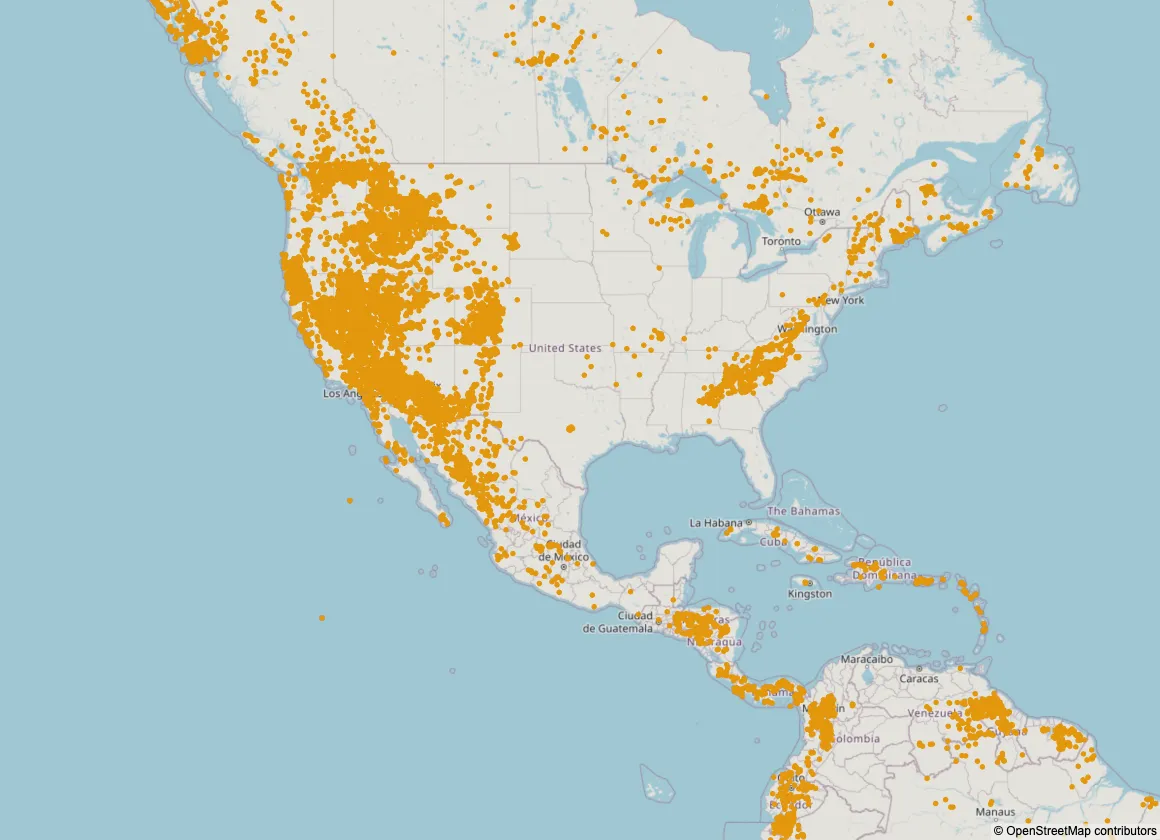
The Pentagon’s MinMod AI is the least speculative fact in the entire AI-mining investment thesis, and it deserves more attention than it gets. In Whitney Tilson’s Mount Rushmore presentation for Stansberry Research, it is Boom Factor #1: “AI just mapped out exactly where our VAST natural mineral wealth lies,” specifically, “the Pentagon’s ‘MinMod’ AI mapped out 670,000 mineral sites across America… Including 184,000 gold sites.” Before dismissing the AI mining boom as promo packaging, it is worth understanding what this program is and why it changes the economics of American resource exploration.
What MinMod is
MinMod, the Defense Department’s Minerals Intelligence program, applies machine reading to the enormous scattered record of American mineral data: historical drilling reports, state and federal geological surveys, mining company filings, and academic studies, decades of paperwork that no human team could comprehensively process. The output is a consolidated national mineral database: 670,000 mapped sites, gold, rare earths, copper, antimony, and the rest of the critical-minerals list.
The strategic driver is import dependency, which Tilson states bluntly: “We are 100% reliant on imports for 16 of our most important commodities,” and “China has us in a ‘chokehold’ for more than half of our antimony.” The Pentagon mapping America’s own mineral inventory is the logical response: you cannot secure a supply chain you have not located.
Why the mapping changes the economics
Mineral exploration has always been the industry’s worst odds: enormous spending on drilling, with the vast majority of programs finding nothing economic. AI-assisted targeting attacks exactly that cost structure. The private-sector proof set Tilson assembles: Earth AI is posting discovery hit rates “150 times the industry average.” KoBold Metals, the Bill Gates, Jeff Bezos, Sam Altman, and Jack Ma-backed AI exploration company, is “now valued at nearly $3 billion.” The results are already repricing stocks: Ramaco Resources made “773% in a little more than six months” after AI-targeted drilling found “1.7 million tonnes of rare earths, worth about $37 billion” under a 100-year-old coal mine. Ero Copper “ran up 318%,” Intrepid Metals “went up 277% in six months,” K2 Gold “soared 711%.”
MinMod as the public layer of a private boom
What makes MinMod investable rather than merely interesting is the interplay between the public and private layers. The Pentagon’s map tells the government, and indirectly the market, where the resource base sits. The private layer, the Terra AIs, Earth AIs, and KoBold Metals of the industry, turns targets into discoveries. And the Rushmore story shows the mechanism reaching mid-tier producers: Dakota Gold’s geologists “got access to 145 years of historic records for the area… It was way too much information for humans to sift through… but not AI. The firm put all this historic data into AI-powered mining software… And it uncovered 114 tons of gold.” That is MinMod’s technique, archival data mining, applied by a listed company, and it produced “one of the biggest, and most important, gold finds in America since the 1870s.”
The policy tailwind behind it
MinMod does not stand alone. Tilson’s Boom Factor #2 is the White House backing, “12 executive orders” supporting resource stocks, and “Project Vault,” “a $12 billion mineral stockpile,” which converts the mapping into purchasing demand. Secretary of the Interior Doug Burgum’s estimate of “a $200 TRILLION payload” of American mineral wealth frames the national-scale version of the same story. The honest read on that number: it is a Cabinet official’s estimate of total in-ground value, not an addressable market for any listed company. But the direction is consistent across every layer: mapped resources, funded stockpiles, and an industry whose discovery economics just improved by orders of magnitude. Our Project Vault: America’s $12 Billion Mineral Stockpile explainer covers this in detail.
What MinMod means for investors
MinMod is the most underappreciated fact in the whole Rushmore presentation: the Pentagon’s AI system that has “mapped out 670,000 mineral sites across America… Including 184,000 gold sites.” That is a public, checkable mapping layer sitting on top of the entire resource thesis. When the federal government has already spent the money to locate the deposits, the marginal cost of exploration for private companies drops, and that is the economics behind Tilson’s claim that AI is “America’s ‘secret weapon’” for discovery.
The investment logic follows the layers. Mapping is public. Discovery rights are private. The companies that combine MinMod-style data with their own drilling programs, the way Dakota Gold’s geologists combined 145 years of archival records with AI-powered mining software to find 114 tons of Black Hills gold, are where the hit-rate improvement shows up in equity value. Earth AI’s discovery rate, 150 times the industry average, is the proof point the presentation leans on, and it is the right one.
Questions readers ask
Is MinMod an investable thing by itself? No, it is a government program, but it functions as a public research subsidy to the entire sector. The tradable expressions are the exploration firms using AI on their own data, the producers closest to development, and the critical-minerals supply chain the mapping is meant to de-risk.
How does the stockpile connect? The $12 billion Project Vault stockpile and the 12 executive orders are the demand-side commitment; MinMod is the supply-side tool. Together they are the two halves of the “biggest resource boom in American history” framing. The honest caveat stays the same: the $200 trillion Burgum number is an in-ground estimate, not realizable value. Our full review keeps all the layers straight.
Where to learn more
For the investment expression, see our coverage of critical minerals stocks, rare earth mining stocks, and how to invest in gold mining companies. Tilson’s full presentation, including the four AI Miners picks, is at the Stansberry order page with the 30-day refund guarantee.
NewsletterVetter is an independent publication. We receive compensation from some of the services we review through affiliate links. Nothing on this site is investment advice. Always do your own research.