The End of Elon? American Atlas Review (2026): Is Marc Chaikin’s Power Gauge Report Still Worth It?
Marc Chaikin has refreshed his “American Atlas” presentation, and this time the hook has teeth: Elon Musk has just become the world’s first trillionaire, and Chaikin’s argument is that the same milestone could mark “the beginning of the end” for the current shape of the AI boom. The pitch warns of an “AI collapse of 2026,” which we examine on its own terms in our dedicated collapse analysis, points to a supercomputer being assembled behind the fences of the same Tennessee lab that launched the Manhattan Project, and puts a $248 trillion number on what comes next. As always with Chaikin, he names his first pick for free: Advanced Micro Devices (AMD).
We have reviewed this American Atlas thesis before, in our original End of Elon review, and we still consider it one of the most technically substantive AI-era pitches on the market. This new cut of the presentation adds a trillionaire framing, a sharper “collapse” warning, and a dated start window of September 29th. Here is the full review of what’s new, what holds up, and what the offer actually costs.

The Presenter
Marc Chaikin entered the markets in 1965, and the presentation leans on that tenure directly: “I consider this one of the most important predictions of my 60-year career.” His institutional background is the kind that survives fact-checking. As the promo puts it, “His former clients have included George Soros, Michael Steinhardt, Paul Tudor Jones, and Steve Cohen.” That is a genuine who’s-who of hedge fund history, and Chaikin’s name has been attached to their desks for decades.
His most durable contribution is the Chaikin Money Flow indicator, described in the presentation without flattery: “Marc invented one of Wall Street’s favorite stock indicators – found in every Bloomberg and Reuters terminal on the planet today.” That is accurate, and the promo even quantifies the institutional price of that access: “Folks would have to spend $24,000 EVERY SINGLE YEAR to access your indicator on the Bloomberg terminal.” Nasdaq separately hired him to build three new indices for the exchange and invited him to ring the opening bell.
His second act is the Power Gauge, the 20-factor rating system behind Power Gauge Report. The presentation’s track-record reel is long: “Micron Technology before it soared 970% in a year… Celestica before it shot up more than 6,600% on the AI infrastructure boom… And it even flashed BULLISH on Nvidia back in 2014… before it skyrocketed more than 50,000%,” plus a backtest claim that it “would’ve accurately flashed bullish on at least 7 out of the top 10 stocks of the year since 2016.” His macro calls are similarly specific: the COVID crash warning in January 2020, the bottom call “just 24 hours before the greatest market recovery in American history,” the 2022 bear warning, the early-2023 rebound call, the Liberation Day warning, and a recent correction call that landed “just two days” later. We have dug into this track record in detail in our Frontier AI review, and the pattern is real: he has been directionally right on the big turns more often than not, and the presentation includes the honest hedge, “These are long term, maximum gains from stocks flagged by Marc’s system. Past performance is no guarantee of future results.”

The Big Idea
The updated pitch keeps the FP64 thesis at its core and wraps it in a more dramatic frame. The host, Molly Hendrickson, opens with the trillionaire moment: “Elon Musk just became the world’s first trillionaire… at least temporarily… But according to one 60-year Wall Street veteran, it could soon become obvious that this was all the beginning of the end.” From there: “Today’s AI darlings are, in some cases, about to get clobbered… Along with anyone holding shares.”
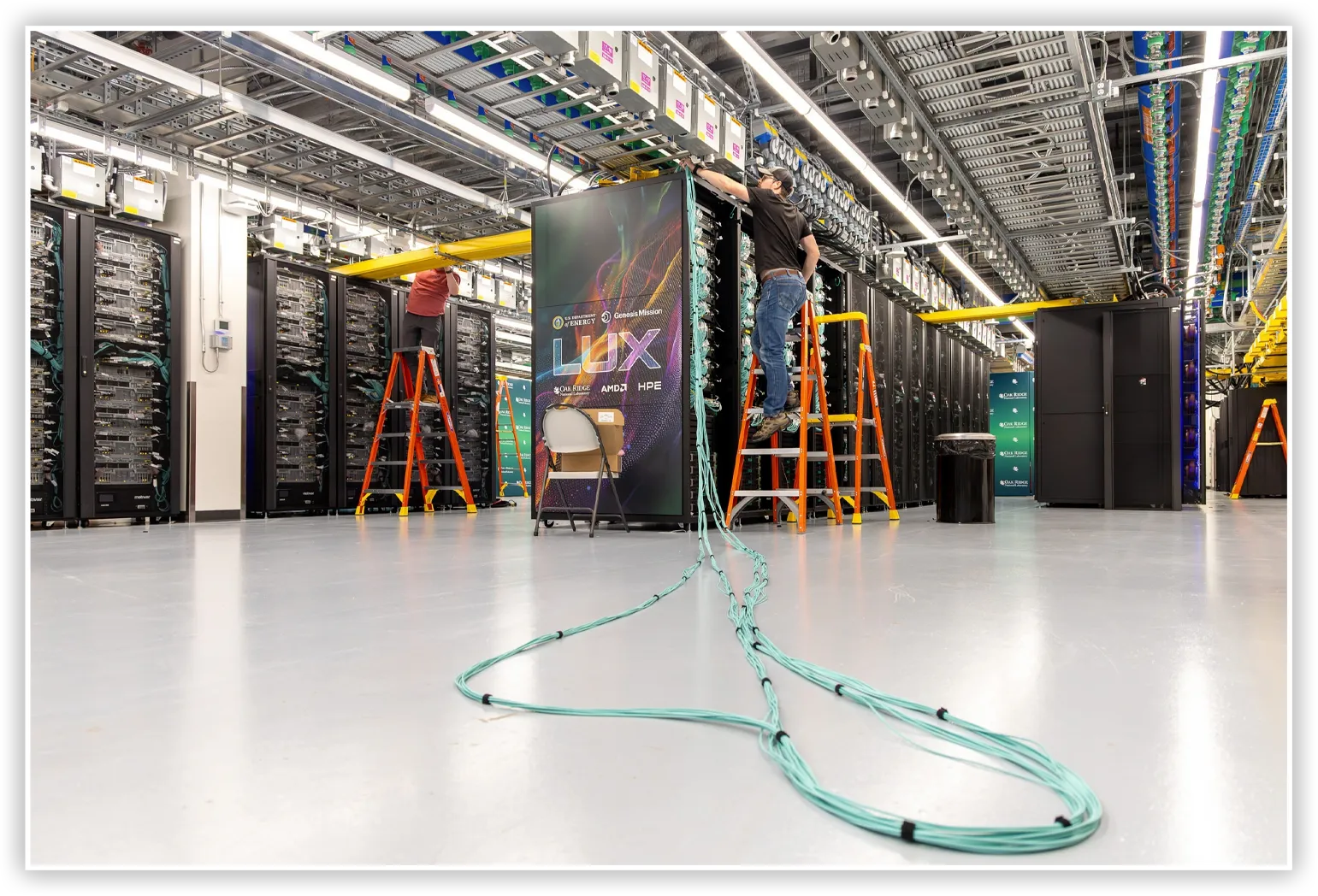
The mechanism is the same one we explained in our original review, and it is worth restating because it is genuinely good computer science. Today’s generative AI runs on low-precision hardware, FP16 and below. Chaikin demonstrates the limitation on camera by asking ChatGPT to count the C’s in “broccoli,” and then explains: “That lack of precision can’t be solved with better programming. You can’t solve it by feeding more data into the models. Because the floating point problem isn’t a software problem. It’s a hardware problem.” The numbers: “FP16 chips can process 65,000 unique values at once… FP64 chips can handle 18 quintillion calculations at once.” Scientific simulation, fusion-reactor design, drug discovery, and materials science all need that double precision, which is why the Department of Energy is building what the promo calls “the world’s first FP64-powered AI supercomputer,” named Lux, at Oak Ridge National Laboratory in Tennessee.
The new framing adds the network effect: Lux is “the first node in what will be a much larger interconnected device,” nine new AI micro clusters plus more than 50 converted DOE supercomputers, “all becoming part of one giant AI breakthrough machine… America’s national AI super brain.” Chaikin names it himself: “So I’m calling this AI supercluster American Atlas.” The scale numbers are the presentation’s most vivid: the new data centers are “about the area of a 7-Eleven convenience store… Literally 0.001% the size of Colossus,” drawing “as little as 24 megawatts” versus Colossus’s 2 gigawatts, yet “more than a trillion times more powerful” for the kind of scientific work that matters. The disruption claim: “a sudden 360-fold acceleration in major AI-powered breakthroughs,” or as he restates it, “going from one mile per hour to 360 miles per hour.” And the disruption price tag: a $248 trillion opportunity built from AI ($23 trillion per McKinsey), nuclear fusion ($40 trillion per Bloomberg), curing cancer ($185 trillion per an Unleash Prosperity study), and quantum computing, which he calls “about 56 times bigger than the first boom.”

The Key Claims
The updated presentation’s claims, in its own words:
“Here’s how this radical new class of AI data centers could also unleash a $248 trillion opportunity starting as soon as September 29th.”
“Imagine an AI data center less than 1% the size of Elon’s Colossus… A next-generation data center that consumes less than 1% of the electricity… And yet… it’s more than 1 trillion times more powerful.”
“it could deliver new breakthroughs in five days compared to five YEARS for Colossus.”
The fear side is the sharpest new element. Chaikin coins a name for the warning itself: “I’m referring to this prediction as the AI White Swan of 2027.” And the freeze instruction is the most aggressive line in the pitch: “Do not buy or sell shares of a single AI stock until you’ve heard what he has to say.” The companion report title carries the same edge: “The Worst AI ‘Landmine Stocks’ to Avoid Right Now,” because “a lot of AI darling stocks are actually doomed right now.”
How to weigh these? The Oak Ridge buildout is real and on a real calendar, so the “before the end of this year” window for Lux coming online has genuine grounding, and the administration’s own framing is quotable: “a historic national effort, comparable in urgency and ambition to the Manhattan Project.” The September 29th date is presented without a stated source. The “don’t touch any AI stock” freeze is the one instruction we’d encourage readers to discount entirely; no honest analyst freezes a whole portfolio pending a newsletter presentation. The $248 trillion is an aggregation of sector forecasts rather than an addressable market for any listed stock, though Chaikin does volunteer the hedge: “Of course, these are extraordinary examples — I can’t promise we will see gains this high.” The testimonials with dollar figures each carry the proper non-typical-results disclosure, and the promo points readers to its own sourcing: “if you’d like to see any of the research behind all the facts and figures I’m sharing, you can do so on our Details and Disclosures section.”

The Free Ticker
The free pick is named plainly: “It’s the first company on my American Atlas ‘buy’ list, Molly. I’m talking about Advanced Micro Devices — ticker symbol AMD.”
The thesis connecting AMD to American Atlas is fact-grounded. AMD’s Instinct accelerators already power the DOE’s flagship machines, Frontier at Oak Ridge and El Capitan at Lawrence Livermore, so AMD’s involvement in the department’s AI push is not a speculative leap. The presentation shows AMD’s “MI430X Instinct Accelerator… ‘engineered specifically for sovereign AI and scientific computing,’” then pivots to “The company just released its brand-new MI455X chips. And we believe they’ll soon be powering Lux – the first of the new AI micro clusters to power American Atlas.” One accuracy note worth flagging: the chip-generation handwave between MI430X and MI455X is held together by “we believe,” so readers should treat the specific Lux-chip claim as expectation rather than contract. The money hook: “At least $1 billion dollars are about to hit this company’s account as a result. The time to invest is now, before the mainstream catches on.”
AMD is a large, liquid mega-cap, which is exactly why it works as the free pick: every viewer can act on it immediately, and it builds trust for the upsell. The picks with the bigger percentage upside, “some of them are absolutely tiny compared to AMD… some of them you’ve probably never heard of before,” sit inside the paid American Atlas Portfolio report, and the first of those is a networking company whose “unsexy” technology “will make the next stage of the AI revolution possible.” We dig into those clue profiles in our original review and our American Atlas Portfolio explained article.
What You Get
The product is Power Gauge Report, Chaikin’s flagship monthly newsletter. The offer includes:
- The American Atlas Portfolio: Top Stocks to Profit from the Dawn of AI Superclusters: the flagship report covering “17 companies that have signed deals… They’re all working directly on building American Atlas.”
- The Worst AI “Landmine Stocks” to Avoid Right Now: the fear-side companion report.
- Full Power Gauge access: “you’ll get full 24/7 free access to Marc’s proprietary Power Gauge system for one full year,” rated “a $1,000 value on its own.”
- Monthly issues, the model portfolio, position updates, and the special-report library.

The price is anchored at $499: “The normal cost for one year of access to Power Gauge Report is just $499… We’ve decided to help you get started at a steeply discounted rate.” The specific discounted price lives on the order-page slide rather than in the transcript, so check the button before assuming the discount. The guarantee is stated three separate times, which we appreciate: “Take a full 30 days to enjoy your new benefits. And if you’re not 100% satisfied, simply let Marc’s member services team know… And you’ll receive a full refund on your subscription, instantly, right away. That puts all the risk on Marc’s side of the table.”
Our Take
We liked this thesis the first time we reviewed it in September, and the substance has not changed. Chaikin is doing something most AI-era promos don’t: teaching real computer science. The FP16 versus FP64 distinction is textbook, the DOE supercomputer buildout is real, Oak Ridge really was the Manhattan Project’s secret city, and AMD really is the chipmaker behind the department’s flagship machines. The free AMD pick is a legitimate, fact-grounded way to act on the thesis without buying anything, which is more than most teaser presentations offer.
The new cut is more aggressive than the original, and that cuts both ways. The trillionaire hook and “AI collapse of 2026” language sharpen the drama but the reader should keep the qualifiers attached: FP64 machines don’t render ChatGPT obsolete, they solve a different class of problem, and the promo’s own subtext (“when it comes to major breakthroughs”) admits it. The “dethrone Elon” framing is marketing; a DOE supercomputer network does not compete with Musk’s net worth in any meaningful sense. The portfolio-freeze instruction (“Do not buy or sell shares of a single AI stock…”) should be ignored outright. And the $248 trillion figure is an aggregation of sector forecasts, not a market any stock addresses.
Our recommendation: for investors who already own mainstream AI names, this presentation is genuinely useful as a map of the next layer of the AI infrastructure story, and the $499-anchored Power Gauge Report, with its 30-day full-refund guarantee and 17-stock Atlas portfolio, is a reasonable way to explore it. The free AMD pick stands on its own regardless. If you want the full mechanism teardown, including the deep dive on the FP64 math and the Oak Ridge timeline, read our original End of Elon review. For the other side of the Musk trade, see our One Stock Retirement Plan review of Jeff Brown’s inference-chip pitch and our Starphone review.
Where to Learn More
- Read our original End of Elon American Atlas review for the full FP64 mechanism teardown, the Oak Ridge timeline, and the clue profiles for all 17 portfolio names.
- For the deeper portfolio breakdown, see American Atlas Portfolio explained and our American Atlas AI supercluster stocks analysis.
- For Chaikin’s prior AI thesis, see our Frontier AI review of his earlier Power Gauge Report pitch.
- For the private-sector Musk builds, see our One Stock Retirement Plan review (inference hardware) and Starphone review (Direct-to-Cell).
- Have a promo you want us to vet? Submit it here.
- Ready to try Power Gauge Report? Click here to see the American Atlas presentation. (Note: a tracked affiliate link for this refreshed promo will replace the direct URL once the tracking code is provisioned.)
NewsletterVetter is an independent publication. We receive compensation from some of the services we review through affiliate links. Nothing on this site is investment advice. Always do your own research.