Starlink Mobile Cost: What Satellite Service Costs
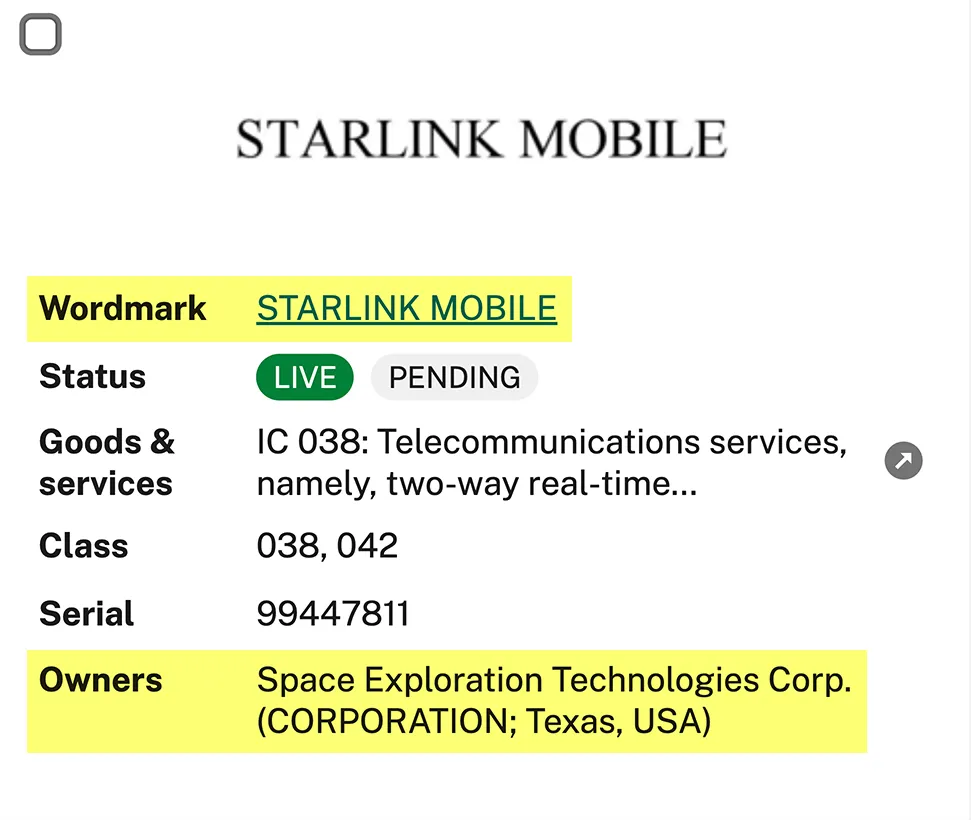
What does Starlink Mobile cost per month? The honest first answer is that no consumer price exists yet. “Starlink Mobile” is a trademark SpaceX filed, on the same day as a companion mark, “Powered by Starlink,” and the service it names has not launched with a published rate card. But the economics that will determine the price are already visible in the assets SpaceX has assembled, and walking through them is the best way to understand what a satellite-native mobile service could charge, and why that question matters to investors rather than just consumers.
The assets that set the price
The spectrum is the anchor purchase. SpaceX “bought exclusive-use, nationwide spectrum from EchoStar. For $17 billion.” Exclusive nationwide spectrum is the scarce input behind every consumer wireless price in America; carriers amortize billions in spectrum cost across monthly subscriber bills. Owning it outright, with no tower buildout to fund, removes the largest fixed cost in terrestrial mobile.
The network is already flying. Starlink makes up “69% of SpaceX’s revenue,” and Musk commands “19 TIMES more active satellites than even the U.S. military, the Chinese military and the Russian military… combined.” The FCC “just approved new rules to make satellite licensing faster and easier” and cleared 15,000 next-gen satellites, “each about 20 times better than current capacity… starting to come online.” The marginal cost of adding a terrestrial-style mobile customer to an already-deployed constellation is closer to software than to infrastructure.
The compute layer is the new variable. The Starmind-class satellites, with the AI1 orbital data-center satellite “the wingspan of a Boeing 747” generating “120 to 150 kilowatts of computing power” on sunlight, point to a future where the intelligence running a phone’s services lives in orbit. Google’s contract, “$920 million a month for SpaceX computing capacity” through 2029, prices that capacity today: hyperscalers are willing to pay data-center rates for orbital compute, which suggests retail AI services could be delivered from orbit at competitive cost.
What the T-Mobile partnership tells us
The clearest window into pricing today is the T-Mobile partnership, which uses Starlink’s Direct-to-Cell satellites to fill coverage gaps for ordinary phones. The pattern Baylin describes is real: carriers partner for coverage, satellites provide it, and D2C service is sold as an add-on layer. “Instead of a bare-bones emergency lifeline, D2C turns Starlink’s satellites into cell towers. So Starphone would be able to text, call, and use the Internet without a cell tower or Wi-Fi.” Our Starlink Direct-to-Cell Partnerships in 2026 explainer covers this in detail.
The strategic implication cuts both ways. As long as Starlink Mobile is a wholesale partner to carriers, its pricing is channel-constrained. If the trademark filings and spectrum purchase signal what Josh Baylin reads into them, a direct-to-consumer service with performance “on par with terrestrial mobile networks” (the language in SpaceX’s SEC IPO paperwork) could price aggressively, because its cost base is satellites already in orbit rather than towers to maintain. That is the scenario in which the price of satellite mobile service undercuts what terrestrial carriers can charge.
Considerations
Every specific monthly figure circulating online for “Starlink Mobile” is invention until SpaceX publishes one. What is verifiable: the $17 billion spectrum purchase, the trademarks, the FCC rulings, the 15,000 next-gen satellites, and the Google compute contract. The investor expression of the theme, in Baylin’s construction, is the suppliers to the buildout, “One of the companies in the report has supplied hardware to SpaceX for close to a decade,” plus his free pick, Qualcomm, “already tapped… to build satellite connectivity into their future devices.” The standard disclaimer applies to all of it: “all investments carry risk, and past performance never guarantees future results.” We break down that angle in our Qualcomm and SpaceX: The Starphone Chip Connection piece.
Questions readers ask about pricing
Is there an official Starlink Mobile price yet? No. The service exists as trademarks, spectrum, and satellites rather than a rate card, so any monthly figure you see is an estimate. What can be priced today is the strategy: the $17 billion EchoStar spectrum buy was for exclusive nationwide use, and Baylin’s read is that Musk will undercut the carriers with a price “the iPhone could NEVER compete with,” in the presentation’s phrasing.
What do the existing economics tell us? Starlink already generates 69% of SpaceX’s revenue, the Google compute contract adds $920 million a month through 2029, and Direct-to-Cell turns satellites into cell towers, which removes the most expensive cost in the carrier model, the tower network. A service built on orbital infrastructure and owned spectrum has a cost structure the incumbents cannot easily match, and that is the real story behind any specific price point.
Where does that leave investors? With a two-layer menu. Qualcomm is the free, liquid way to own the satellite-to-phone transition regardless of pricing. The supplier list in the paid True Innovations Report holds the smaller names, most under $100, that Baylin thinks could deliver the 50x upper tail if the service launches. Pricing news will move both layers, so watch the trademark filings and the licensing docket rather than rumor threads. Our full Starphone review covers the evidence.
Where to learn more
For the surrounding thesis, see our coverage of direct-to-device satellite investing, Starlink stocks, and the Stansberry Research publisher profile. The full Starphone presentation is at the Stansberry order page, with the supplier list and 30-day refund guarantee.
NewsletterVetter is an independent publication. We receive compensation from some of the services we review through affiliate links. Nothing on this site is investment advice. Always do your own research.