Starlink and T-Mobile: The Direct-to-Cell Partnership
The Starlink and T-Mobile partnership is the most concrete, least speculative fact in the entire satellite-to-phone story, and it is the right place for a skeptical reader to start. Unlike the rumored Starphone, this deal shipped: T-Mobile uses Starlink’s Direct-to-Cell satellites to deliver coverage to ordinary, unmodified phones in places terrestrial towers do not reach. Josh Baylin’s Stansberry presentation treats the partnership as proof of concept for a bigger thesis, and it is worth understanding both what the deal proves and what it does not.
What Direct-to-Cell does
Baylin explains the technology crisply: “Instead of a bare-bones emergency lifeline, D2C turns Starlink’s satellites into cell towers. So Starphone would be able to text, call, and use the Internet without a cell tower or Wi-Fi.” The key technical fact is that early Direct-to-Cell service works with existing phones; no special hardware required, because the satellites broadcast on spectrum the carrier partners hold.
The partnership’s significance for the wider thesis is threefold. First, it proves the physics: satellites can serve ordinary handsets at commercial scale. Second, it proves the demand: people pay for coverage beyond towers. Third, it established the template, satellite operator plus carrier, that the whole industry then followed, with other carriers signing Direct-to-Cell-style arrangements of their own.
The strategic wrinkle
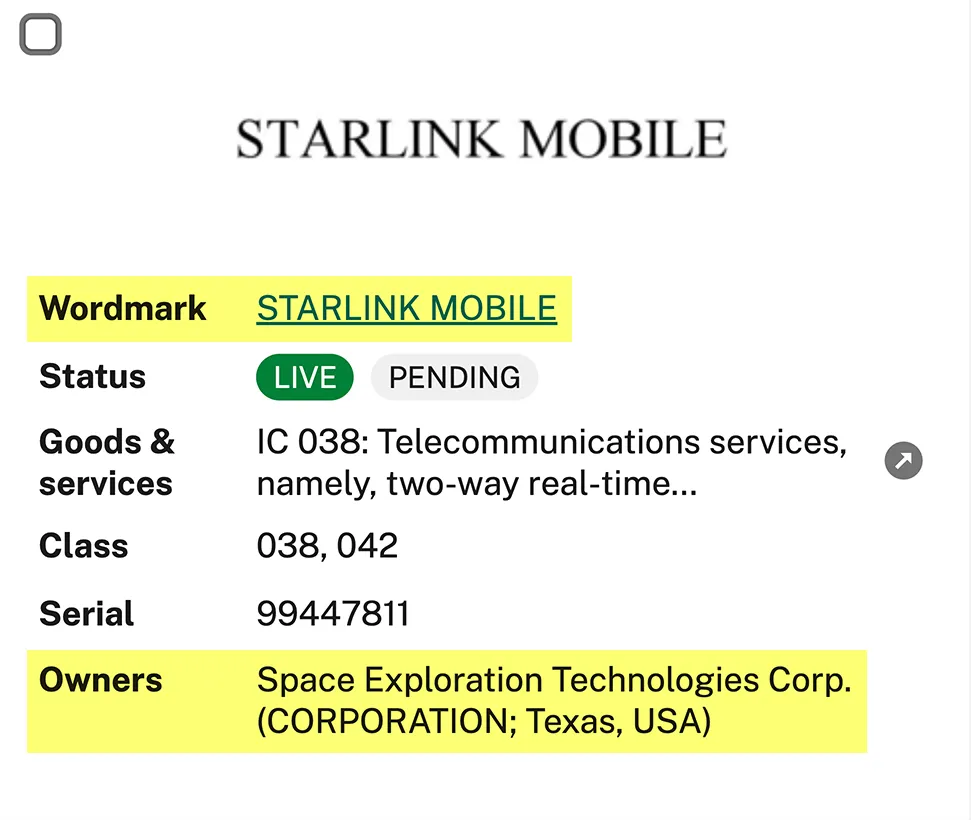
The interesting tension in the T-Mobile deal is what it does not include: exclusivity over the space layer. SpaceX’s subsequent moves read like a company building past the wholesale partnership. It “bought exclusive-use, nationwide spectrum from EchoStar. For $17 billion.” Spectrum the operator owns outright means the ability to serve customers directly, without a carrier in between. The same-day trademark filings, “Starlink Mobile” and “Powered by Starlink,” name a consumer-facing service. And the SEC IPO paperwork describes next-generation direct-to-smartphone service “on par with terrestrial mobile networks,” which is a performance claim aimed at the mainstream market, not the emergency-texting niche.
Why the partnership still matters
Even under an aggressive Starlink Mobile scenario, the T-Mobile partnership keeps strategic value. It generates revenue on the existing constellation, it normalizes satellite connectivity in the mass market, and it built the ground-game relationships, billing, support, distribution, that a direct service would need anyway. For investors, it also anchors the supplier thesis: the Direct-to-Cell buildout is happening now, regardless of whether any Musk-built phone ever ships. The FCC’s new rules “to make satellite licensing faster and easier” and the 15,000 next-gen satellites “each about 20 times better than current capacity” coming online are dated, checkable catalysts for the component makers involved. For the full backstory, see our Starlink Mobile Cost: What Satellite Service Costs article.
Baylin’s free recommendation rides on exactly this logic: Qualcomm, “already tapped, which is a chipmaker, to build satellite connectivity into their future devices. So, when Starphone finally launches… there’s a real chance it runs through Qualcomm’s satellite chip. I think the stock could easily double over the next few years.” Note the structure of that claim: the doubling case is stated over years and rests on the broader satellite-connectivity shift, not on a single device. For the full backstory, see our Qualcomm and SpaceX: The Starphone Chip Connection article.
Considerations
The honest frame for T-Mobile investors is different from the satellite-supplier frame. T-Mobile gains a differentiated coverage story and a first-mover partnership; the risk side is that its space-layer partner may become its competitor, given the spectrum and trademark trail above. The wholesale-versus-direct question is the one to watch in SpaceX’s IPO disclosures. And the blanket disclaimer applies as always: past supplier runs, like EchoStar going “from $15 to $127 in less than a year” on the spectrum news, are historical facts, not forecasts.
Questions readers ask about Starlink Mobile and T-Mobile
What are the “Starlink Mobile” trademarks? SpaceX filed two trademarks the same day, “Starlink Mobile” and “Powered by Starlink,” alongside its $17 billion exclusive nationwide spectrum purchase from EchoStar. Together they are the strongest paper-trail evidence that a direct-to-phone service branded Starlink Mobile is being built, even though Musk denied the prototype story reported by the Wall Street Journal.
Doesn’t the T-Mobile partnership contradict a Starphone? Not really, and this is the subtle part. The existing T-Mobile arrangement brings Direct-to-Cell text and data to ordinary phones, which builds the network layer and the regulatory record while remaining carrier-centered. A Starlink Mobile-branded service with exclusive spectrum could sit on top of that same satellite constellation. Baylin’s semantic-loophole argument is precisely that Musk can deny a phone while building everything a phone needs.
What are the investment implications? The network layer is the least speculative part of the story. Starlink already makes up 69% of SpaceX revenue, SpaceX fields 19 times more active satellites than the U.S., Chinese, and Russian militaries combined, and the FCC has approved new rules making satellite licensing faster. The publicly tradable expressions today are the suppliers: Qualcomm, with its announced satellite-connectivity partnership, is the free pick, and the under-$100 supplier names sit in the paid report. The Google contract, $920 million a month through 2029 for orbital compute, adds a second revenue leg. We lay out the whole map in our full Starphone review.
Where to learn more
See our related coverage of direct-to-device satellite investing, satellite communication stocks, and the Stansberry Research publisher profile. The full Starphone presentation, including the supplier list offer, is at the Stansberry order page with the 30-day refund guarantee.
NewsletterVetter is an independent publication. We receive compensation from some of the services we review through affiliate links. Nothing on this site is investment advice. Always do your own research.